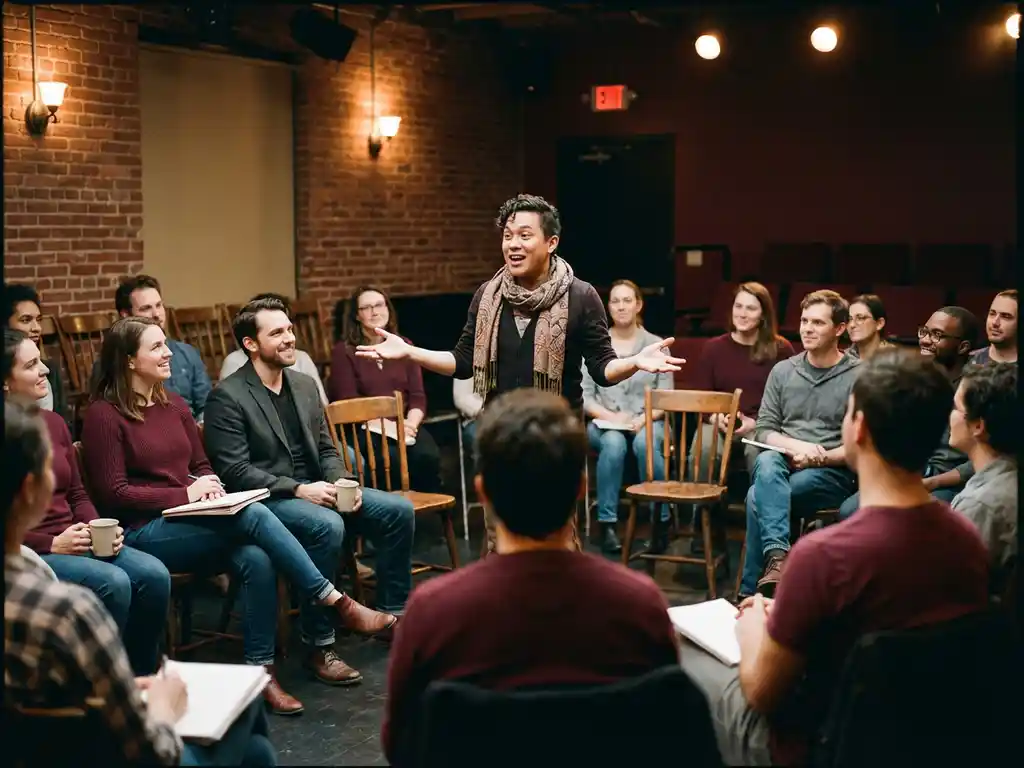
Internal culture rarely transforms through memos or slide decks. It shifts when people feel heard, connected, and genuinely inspired by the stories shared around them. A storytelling workshop for companies gives teams practical tools to communicate in ways that actually stick, replacing dry information dumps with narratives that move people to action.
Whether your organization is navigating change, struggling with siloed departments, or simply trying to make town halls less painful, corporate storytelling is one of the most underutilized levers available to leaders and communicators. Here are 11 concrete ways a storytelling workshop transforms internal culture from the inside out.
Why storytelling is your culture’s missing link
Most organizations invest heavily in communication tools but very little in communication craft. The result is a workforce drowning in information yet starved of meaning. Research consistently shows that humans process and retain stories far more effectively than facts presented in isolation, making business storytelling a foundational skill rather than a nice-to-have.
Culture is ultimately the sum of the stories an organization tells about itself: who we are, what we value, and where we are going. When those stories are unclear, inconsistent, or simply absent, employees fill the gaps with uncertainty and rumor. A storytelling workshop gives your people a shared language and structure to build culture intentionally rather than accidentally.
1: Cuts through information overload instantly
The average professional receives well over 100 emails a day, and leaders consistently rank breaking through information overload as one of their top communication challenges. A well-structured story bypasses the noise because it creates a beginning, tension, and a resolution that the human brain is wired to follow.
Storytelling training teaches employees to lead with context and conflict rather than bullet points and data. When your message has a narrative arc, it earns attention instead of competing for it. Teams walk away from workshops with practical frameworks for distilling complex information into clear, compelling communication that actually gets read and remembered.
2: Builds psychological safety across teams
Psychological safety, the belief that you can speak up without fear of judgment, is the foundation of high-performing teams. Storytelling workshops create a low-stakes environment where participants practice vulnerability and active listening in equal measure.
When team members share personal, professional stories, they discover common ground they never knew existed. That shared humanity reduces defensiveness and builds the kind of trust that makes honest feedback, creative risk-taking, and open dialogue possible in everyday work.
3: Strengthens cross-departmental understanding
Siloed communication is one of the most persistent challenges in larger organizations. Departments develop their own language, priorities, and blind spots, making genuine collaboration feel like translation work. Storytelling workshops break this pattern by teaching people to frame their work in terms of impact and human experience rather than technical function.
When a finance team learns to tell the story behind the numbers, or when an operations team shares the human challenges behind a process change, other departments begin to see them differently. Cross-departmental empathy grows naturally when people stop presenting data and start sharing perspective.
4: Makes change management messages land
Organizational change fails most often not because the strategy is wrong but because the communication around it is unconvincing. Employees need to understand not just what is changing but why it matters and what it means for them personally. That is a storytelling challenge, not an information challenge.
A storytelling workshop equips leaders and change champions to craft narratives that acknowledge the tension of transition while pointing toward a credible and inspiring future. When people see themselves as characters in a meaningful story rather than recipients of a directive, their willingness to engage with change increases significantly.
5: Boosts employee engagement and participation
Disengagement often stems from employees feeling like passive observers in their organization’s story rather than active contributors. When people are given the tools and the invitation to share their own narratives, their sense of ownership and belonging grows.
Storytelling workshops shift internal communication from broadcast to conversation. Participants learn how to listen as actively as they speak, creating the kind of reciprocal dialogue that makes employees feel genuinely valued. Higher engagement follows naturally when people believe their voice shapes the story being told.
6: Sharpens leadership communication skills
Effective leaders are effective communicators, and effective communicators are almost always skilled storytellers. Storytelling training gives leaders a structured approach to inspire rather than simply inform, helping them move audiences from awareness to action.
Workshops focused on narrative structure, emotional resonance, and delivery help leaders at every level communicate with greater clarity and confidence. Whether addressing a team of five or an all-hands meeting of five hundred, leaders who can tell a compelling story hold attention and build credibility in ways that slide decks alone never achieve.
7: Reinforces company values through narrative
Company values displayed on a wall rarely change behavior. Values embedded in stories that people actually tell and retell do. Storytelling workshops teach teams to identify and articulate the moments when organizational values come to life in real situations.
When employees can connect a value like “customer obsession” or “radical transparency” to a specific story from their own experience, that value becomes tangible and actionable rather than aspirational and abstract. Over time, these shared stories become the cultural reference points that guide decisions at every level.
8: Improves internal presentations and town halls
Town halls and all-hands meetings are among the most expensive communication investments an organization makes, yet they are frequently among the least effective. Audiences disengage when presentations feel like data recitals rather than meaningful conversations.
Storytelling training gives presenters the tools to open with a hook, build tension around a real challenge, and close with a call to action that resonates. Internal presentations become events people actually look forward to because they deliver insight, energy, and connection rather than just information.
9: Drives collaboration through shared narratives
Collaboration is most effective when teams share a common understanding of purpose and direction. Storytelling workshops help teams build that shared narrative by aligning around a collective story of where they are, what obstacles they face, and what success looks like together.
When a team has co-created its own story, members feel a stronger sense of mutual accountability. They are working toward a shared outcome they helped define rather than executing a plan handed down from above. That distinction makes a significant difference in both motivation and creative problem-solving.
10: Measures communication effectiveness better
One of the persistent challenges in internal communication is the gap between how leaders perceive their messaging and how employees actually experience it. Research suggests that while most leaders believe their communications are clear and engaging, fewer than half of employees agree.
Storytelling workshops introduce teams to the concept of narrative feedback: structured ways to assess whether a story landed as intended, what emotions it triggered, and what action it inspired. These qualitative measures complement traditional engagement surveys and give communicators richer, more actionable insight into what is and is not working.
11: Creates a lasting culture of open communication
The most valuable outcome of a storytelling workshop is not a single skill but a lasting shift in how an organization communicates. When teams experience firsthand that stories create connection, clarity, and trust, they carry that understanding into every meeting, email, and conversation that follows.
Over time, storytelling becomes a shared cultural practice rather than a one-off training exercise. Teams begin to look for the narrative in every challenge, and leaders start framing decisions in terms of the story they want their organization to tell. That is how a workshop becomes a culture change.
How Boom For Business helps transform your internal culture through storytelling
We have spent over 30 years helping organizations communicate with more clarity, confidence, and genuine human connection. Our storytelling workshops are built on the proven methodologies of Boom Chicago, combining professional development with the kind of energy and humor that makes learning stick. Here is what we bring to the table:
- Customized storytelling workshops designed around your organization’s specific challenges, whether that involves change management, leadership communication, or cross-departmental collaboration
- Experienced facilitators who understand corporate environments and know how to create psychological safety that encourages real participation
- Improvisation-based techniques that make abstract storytelling principles immediately practical and applicable in everyday professional situations
- Interactive formats that work for teams of all sizes, from leadership offsites to company-wide events and town halls
- A track record of impact backed by an average Google rating of 4.5 across more than 1,700 reviews from international organizations
If you are ready to move beyond communication that informs and toward communication that truly transforms, we would love to help you get there. Explore our Masterclass Workshops to see how storytelling training fits your team’s needs, or discover how our approach supports positive culture building across your organization. You can also browse our full range of team building experiences or simply visit Boom For Business to start the conversation.
Frequently Asked Questions
How long does a storytelling workshop typically take, and how many employees should participate?
Most corporate storytelling workshops run anywhere from a half-day session to a full two-day immersive experience, depending on your goals and team size. Smaller, focused groups of 10–20 participants tend to yield the deepest results because they allow for meaningful practice and personal sharing, but formats can be adapted for larger all-hands events as well. The right length and group size ultimately depend on whether you are targeting a specific team, a leadership cohort, or your entire organization.
How soon after the workshop can we expect to see a shift in our internal culture?
Some changes, like improved meeting dynamics and more confident communication from participants, are often visible within days of the workshop. Deeper cultural shifts, such as cross-departmental empathy and a sustained habit of narrative thinking, typically take three to six months to fully take root, especially when leadership actively models the skills learned. Pairing the workshop with follow-up check-ins or reinforcement sessions significantly accelerates the timeline.
What if our employees are skeptical or resistant to participating in a storytelling workshop?
Skepticism is completely normal, particularly in data-driven or highly technical cultures where storytelling may feel soft or unrelated to day-to-day work. The best facilitators address this upfront by anchoring the workshop in measurable business outcomes, such as faster stakeholder buy-in, reduced miscommunication, and stronger change adoption, rather than leading with abstract creative concepts. Starting with a shorter, lower-commitment format like a lunch-and-learn or keynote session can also help skeptical teams experience the value before committing to a full workshop.
Do participants need any prior experience with public speaking or storytelling to benefit from the workshop?
No prior experience is needed, and in fact, complete beginners often experience the most dramatic growth. Storytelling workshops are designed to meet participants where they are, using structured frameworks and low-pressure practice exercises to build confidence gradually. The skills taught, such as narrative arc, leading with context, and emotional resonance, are practical and immediately applicable regardless of someone's starting point.
How do we measure the ROI of a storytelling workshop for internal culture?
ROI can be tracked through a combination of qualitative and quantitative measures, including pre- and post-workshop engagement survey scores, changes in participation rates at town halls, employee Net Promoter Score (eNPS), and direct feedback collected using narrative feedback techniques introduced during the workshop itself. Leaders can also track softer indicators like the quality of cross-departmental communication, the frequency of story-driven messaging in internal channels, and the speed at which change initiatives gain employee buy-in. Establishing a baseline before the workshop makes it much easier to demonstrate impact afterward.
Can storytelling workshops be customized for specific business challenges, like a merger or a major organizational restructuring?
Absolutely, and this is where customization delivers the greatest value. A workshop designed around a specific challenge, such as communicating the rationale behind a merger, rebuilding trust after a restructuring, or aligning a newly formed team, will be far more effective than a generic training program. Experienced facilitators work with your leadership team in advance to understand the context, tailor the narrative frameworks to your situation, and ensure participants leave with stories they can actually use in the weeks that follow.
What is the difference between a storytelling workshop and standard communication or presentation skills training?
Traditional communication training tends to focus on delivery mechanics, things like slide design, vocal projection, and body language, whereas storytelling workshops go deeper into the structure and emotional architecture of the message itself. Storytelling training teaches people why certain messages move people to action and others do not, giving communicators a more powerful and transferable skill set. The result is not just better presenters but better thinkers who approach every email, meeting, and conversation with a narrative mindset.
Related Articles
- 11 things every successful teambuilding workshop has in common
- How do you justify the cost of team building activities to a skeptical CFO?
- How does event moderation work in digital formats?
- How do comedy-based team building programs reduce workplace stress?
- How do you measure whether a corporate workshop actually changed anything?