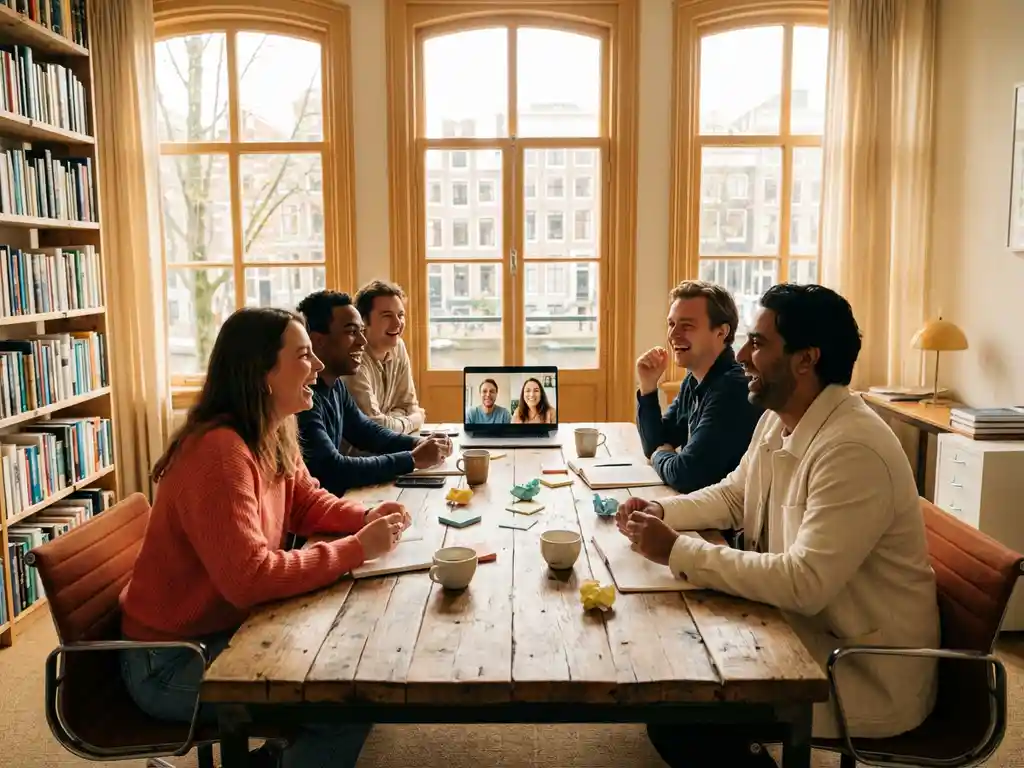
Hybrid and distributed teams have become the norm for many organizations, but that shift has not come without friction. When some colleagues gather in a conference room while others dial in from home offices, kitchen tables, or co-working spaces across time zones, the conditions for strong teamwork become uneven by default. The challenge is real: how do you genuinely improve teamwork in the workplace when your team does not share the same physical space every day?
The good news is that hybrid collaboration is absolutely achievable with the right structures, habits, and mindset in place. The seven strategies below offer practical, concrete ways to strengthen remote teamwork and team engagement, no matter where your people are working.
Why hybrid teams struggle with teamwork
Before jumping into solutions, it helps to understand what makes hybrid team collaboration uniquely difficult. The core problem is asymmetry. In-office employees benefit from spontaneous hallway conversations, shared body language, and a natural sense of inclusion. Remote colleagues, meanwhile, often miss out on informal moments that build trust and alignment over time.
This imbalance quietly erodes team cohesion. Distributed teams frequently report feeling disconnected from decisions, excluded from social dynamics, and uncertain about where they stand. Add the noise of overflowing inboxes and back-to-back video calls, and it becomes clear why workplace communication suffers. Addressing these challenges requires intentional design, not just goodwill.
1: Build shared rituals that connect remote and in-office staff
Shared rituals are one of the most effective ways to improve teamwork in the workplace for hybrid teams. A ritual does not need to be elaborate. It simply needs to be consistent, inclusive, and genuinely enjoyable for everyone involved, regardless of location.
Think weekly team check-ins with a standing icebreaker question, a shared digital space for celebrating wins, or a monthly virtual social that everyone actually looks forward to attending. The key is designing rituals that do not privilege in-office participants. When remote team members feel like full participants rather than observers, trust builds naturally, and team engagement rises alongside it.
2: Use structured communication to cut through the noise
Unstructured communication in hybrid environments quickly becomes chaotic. When information flows informally, remote employees are the first to be left out of critical updates, and in-office staff often receive duplicate or conflicting messages. Structured communication solves this by creating clear channels, expectations, and rhythms for how information moves through the team.
Practical steps include defining which tools are used for which types of messages, setting response-time norms, and creating a single source of truth for project updates. Asynchronous communication should be the default for non-urgent matters, freeing up live meetings for decisions and genuine collaboration. When everyone knows where to look and what to expect, workplace communication becomes far less exhausting and far more effective.
3: Create equal participation across locations
Hybrid meetings tend to favor whoever is in the room. In-office employees speak more freely, read the room, and build rapport with leadership in ways that remote colleagues simply cannot replicate over video. Left unaddressed, this dynamic creates a two-tier team culture that undermines morale and remote teamwork alike.
Equalizing participation requires active facilitation. Designate a meeting role specifically focused on amplifying remote voices. Use digital collaboration tools like shared whiteboards or polling platforms so everyone can contribute simultaneously. Rotate meeting facilitation among team members, including those working remotely. These small structural shifts signal that every voice carries equal weight, which is foundational to strong hybrid team collaboration.
4: What makes team building actually work for hybrid teams?
Corporate team building earns a bad reputation when it feels forced, irrelevant, or designed only for people in the same room. For hybrid teams, the bar is higher. Effective team building must be genuinely engaging, location-agnostic, and directly connected to how the team actually works together.
The most successful team building activities for distributed teams share a few characteristics. They are interactive rather than passive, they create shared experiences rather than parallel ones, and they leave participants with something real—whether that is a new communication habit, a deeper understanding of a colleague, or simply a reason to laugh together. Humor, in particular, is a powerful connector. It lowers defenses, creates memorable moments, and builds the kind of psychological safety that makes teams more creative and resilient over time.
5: Break down silos with cross-team collaboration moments
Siloed departments are a persistent challenge in large organizations, and hybrid work can make them worse. When teams rarely share physical space, the invisible walls between departments become even harder to see and even harder to break down. Cross-team collaboration moments are a deliberate antidote to this pattern.
These do not need to be formal initiatives. A monthly cross-departmental problem-solving session, a shared project between two teams that would not normally interact, or even a casual virtual coffee-pairing program can begin to dissolve the barriers that prevent knowledge sharing. The goal is to create enough regular touchpoints that employees start to see the broader organization as their team, not just their immediate department.
6: Use storytelling to align teams around shared goals
Data and slide decks communicate information, but stories create understanding. When hybrid teams are working toward shared goals, storytelling is one of the most powerful tools available for building genuine alignment. A well-told story about why a project matters, what impact it will have, or how a team overcame a specific challenge sticks in ways that bullet points simply do not.
Leaders and team members alike can develop storytelling skills with practice. Encourage teams to open project updates with a brief narrative context before diving into metrics. Create space for employees to share their own experiences of the work. When people understand not just what they are doing but why it matters, engagement deepens, and distributed teams pull in the same direction with much greater consistency.
7: Measure team health beyond productivity metrics
Productivity metrics tell you what a team is producing. They rarely tell you how the team is doing. For hybrid and distributed teams, measuring team health requires looking at indicators that go beyond output: psychological safety, communication quality, inclusion, and a sense of belonging all play a significant role in long-term performance.
Simple pulse surveys, regular one-on-one conversations, and retrospective sessions where teams reflect on how they are working together (not just what they delivered) provide valuable insight. When team leaders actively track and respond to these softer signals, they catch problems early and demonstrate that the human side of teamwork is taken seriously. This is especially important for remote employees who may feel their experience is invisible to leadership.
Start building a team that thrives anywhere
Improving teamwork in the workplace for hybrid and distributed teams is not a one-time fix. It is an ongoing commitment to creating conditions where every team member, regardless of location, feels genuinely included, heard, and connected to shared goals.
At Boom For Business, we help organizations build exactly that. Drawing on over 30 years of expertise in improvisation, storytelling, and interactive facilitation, we design experiences that bring hybrid teams together in ways that are energizing, memorable, and genuinely effective. Here is how we can support your team:
- Masterclass Workshops that develop real communication and collaboration skills through humor-infused, hands-on learning, covering storytelling, presentation, and creative thinking
- Custom team building programs designed to work for both in-office and remote participants, creating shared experiences that build trust across locations
- Event hosting and facilitation that ensures equal participation and genuine engagement, whether your team is in one room or spread across the globe
- Culture and change programs that use business-friendly humor to help teams navigate transformation, reduce friction, and realign around shared purpose
If you are ready to strengthen your hybrid team and create a workplace culture where collaboration actually thrives, we would love to help. Explore our Masterclass Workshops, discover our team building programs, or learn how we support positive culture development. Visit Boom For Business to find out how we can create something memorable for your team.
Frequently Asked Questions
How do we get leadership buy-in to invest time and resources into hybrid team building?
The most effective approach is to connect hybrid team health directly to business outcomes leadership already cares about — retention, productivity, and innovation. Present data from pulse surveys or retrospectives that reveal disconnection or disengagement, and frame team building as a proactive investment rather than a discretionary perk. Pilot a single low-cost initiative, measure its impact on engagement or communication quality, and use those results to make the case for broader commitment.
What are the most common mistakes teams make when trying to improve hybrid collaboration?
The most frequent mistake is designing processes and rituals around in-office employees and then simply streaming them to remote participants — which reinforces the two-tier dynamic rather than resolving it. Another common pitfall is over-relying on video calls as the default solution for everything, which leads to meeting fatigue without actually improving connection. Effective hybrid collaboration requires building systems that are remote-first by design, not remote-adapted as an afterthought.
How often should hybrid teams run team building activities to actually see a difference?
Consistency matters far more than frequency or scale. A brief, well-designed touchpoint every two to four weeks tends to outperform a single large annual event in terms of sustained trust and engagement. The goal is to make connection a regular rhythm rather than a one-off occasion — small shared rituals, cross-team moments, and structured check-ins compound over time and create lasting cultural change.
Our team spans multiple time zones — how do we make participation fair when no single meeting time works for everyone?
Rotate meeting times so the inconvenience is shared equitably rather than consistently falling on the same people. Pair live sessions with robust asynchronous alternatives — recorded summaries, collaborative documents, or async video tools like Loom — so those who cannot attend in real time can still contribute meaningfully and stay informed. The key principle is that no team member should feel permanently disadvantaged simply because of where they live.
How do we measure whether our hybrid team building efforts are actually working?
Look beyond attendance numbers and post-event satisfaction scores. Track indicators like psychological safety (through anonymous pulse surveys), the quality and inclusivity of communication in meetings, and whether remote employees report feeling equally informed and valued over time. Running short retrospectives after team initiatives — asking what improved, what still feels broken, and what to try next — gives you actionable feedback and signals to the team that their experience genuinely matters.
Can humor and improv-based approaches really work for professional, results-driven teams?
Absolutely — and the research supports it. Humor in professional settings has been shown to increase psychological safety, reduce stress, and improve creative problem-solving, all of which directly contribute to better collaboration and performance. Improv-based methods work particularly well for hybrid teams because they are inherently participatory, require active listening, and create shared experiences that translate across locations. The key is facilitation that keeps the focus on real skills — communication, adaptability, storytelling — rather than entertainment alone.
Where should a team leader start if their hybrid team is already showing signs of disengagement or low morale?
Start with listening before launching any initiatives. Hold brief one-on-one conversations or send a short anonymous survey to understand where the disconnection is actually coming from — whether it is communication gaps, exclusion from decisions, lack of recognition, or something else entirely. Once you have a clearer picture, choose one or two targeted interventions rather than overhauling everything at once. Quick wins, like introducing a structured weekly check-in or a shared wins channel, can rebuild momentum and demonstrate that leadership is paying attention.
Related Articles
- How does a photo challenge team building activitie work?
- 9 creativity workshop structures for departments that think they are not creative
- 9 team building activities that work for both introverts and extroverts
- How do you choose the right event host for your company?
- What are the key responsibilities of an event moderator?