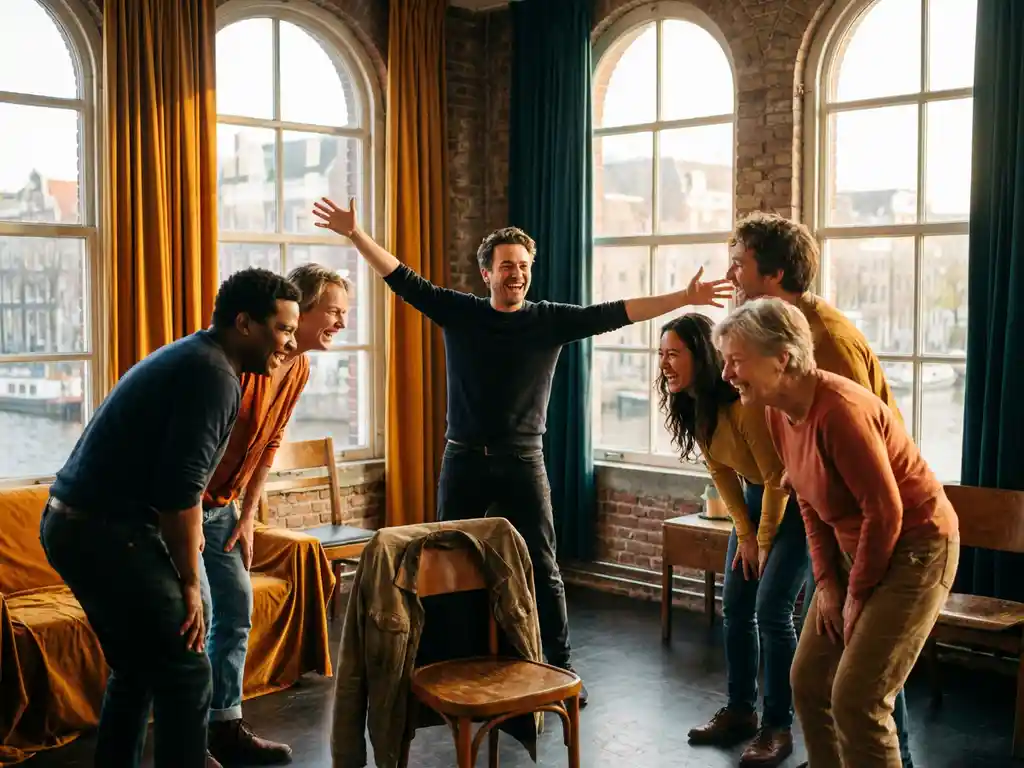
Not all team-building activities are created equal. Some leave people laughing and energized, while others create genuine shifts in how a team communicates, collaborates, and connects. Understanding the difference between a fun team-building activity and a truly meaningful one can help you make smarter decisions for your organization and get real results from the time and budget you invest.
Whether you are planning a corporate event in Amsterdam or looking for effective team-building solutions for a distributed workforce, this guide answers the questions that matter most—from what makes team building actually work to how humor can become one of your most powerful professional tools.
What is the difference between fun and meaningful team building?
Fun team building creates enjoyment in the moment. Meaningful team building creates lasting change in how people work together. The key distinction is transfer: a meaningful activity gives participants skills, insights, or connections they carry back into their daily work. Fun is a feature of great team building, but it is not the outcome on its own.
Think of it this way: a fun activity might generate laughter and good memories, but a meaningful one changes behavior. When team members leave an experience with a new way of listening, a stronger sense of psychological safety, or a shared language for solving problems, that is when team building has done its real job. The best corporate team-building programs achieve both, making the experience enjoyable while embedding something genuinely useful.
Why does team building matter beyond just having fun?
Team building matters because healthy team dynamics directly affect productivity, communication, and employee engagement. When people trust each other, share information openly, and feel valued within their team, they perform better and stay longer. Fun is what gets people in the room; meaningful outcomes are what justify the investment.
Organizations often underestimate how much poor team dynamics cost them. Miscommunication, siloed departments, and disengaged employees are not just morale problems; they are performance problems. Effective team building addresses the root causes of these issues by creating shared experiences that build trust and open dialogue. When employees feel genuinely connected to their colleagues, they are more likely to collaborate proactively, speak up with ideas, and support each other through challenges.
What makes a team-building activity truly effective?
A truly effective team-building activity has a clear purpose, active participation, and a visible connection to real workplace challenges. It moves people out of their comfort zones in a safe way, encourages genuine interaction rather than performance, and produces takeaways that participants can apply immediately.
Key characteristics of effective team building
- Clear learning objectives: The activity is designed around a specific outcome, such as improving communication, building trust, or encouraging creative thinking.
- Active involvement: Everyone participates rather than observing. Passive experiences rarely create lasting change.
- Psychological safety: People feel comfortable taking risks, making mistakes, and being themselves without fear of judgment.
- Relevance to real work: The skills or insights gained mirror challenges the team actually faces on the job.
- Skilled facilitation: An experienced facilitator guides the experience, draws out reflection, and connects the activity to broader team goals.
Without these elements, even the most entertaining activity risks becoming just a day out of the office. With them, team building becomes a genuine catalyst for change.
How does humor make team building more meaningful?
Humor makes team building more meaningful by lowering defenses, building psychological safety, and making difficult conversations easier to have. When people laugh together, they feel more connected and more willing to be vulnerable, which are exactly the conditions needed for real collaboration and honest communication to thrive.
This is not about telling jokes. Business-friendly humor—the kind rooted in improvisation and storytelling—teaches people to listen actively, respond in the moment, and embrace uncertainty without shutting down. These are core professional skills wrapped in an experience that feels natural and energizing rather than forced. Research consistently shows that laughter reduces stress and increases openness, making teams more receptive to new ideas and perspectives.
Humor also creates memorable moments. When a team shares a genuinely funny, slightly uncomfortable, or surprisingly creative experience together, they build a shared story. That shared story becomes part of the team’s identity and a reference point they return to long after the event is over.
What’s the difference between team building and team bonding?
Team bonding focuses on social connection and enjoyment, while team building focuses on developing skills and improving how a team functions. Bonding activities, like a group dinner or a social outing, strengthen relationships informally. Team-building activities are structured to produce specific professional outcomes alongside the social connection.
Both have genuine value, and the best programs combine elements of each. A purely social event can feel hollow if a team has underlying communication problems. A purely instructional workshop can feel dry if it lacks warmth and human connection. The sweet spot is an experience that feels like bonding but operates like building, where people enjoy themselves while developing real capabilities together.
When planning your next event, ask yourself: do we want people to feel good together, or do we want people to work better together? Ideally, you want both, and that requires intentional design rather than simply booking something fun.
How do you choose the right team-building activity for your team?
Choosing the right team-building activity starts with identifying your team’s specific needs and goals. The format, tone, and content of the activity should match the challenge you are trying to solve, the size and diversity of your group, and the culture you want to build or reinforce.
Questions to guide your decision
- What is the main challenge this team is facing right now? (Communication gaps, low trust, siloed thinking, post-merger integration?)
- What outcome would make this event a success three months from now?
- What is the energy level and comfort zone of the group?
- Is this a new team that needs to connect, or an established team that needs to grow?
- How much time and budget do you have, and what format suits the occasion?
Once you have clear answers, match the format to the need. High-energy interactive workshops suit teams that need to break down barriers and communicate more openly. Storytelling and presentation masterclasses work well for teams that need to align around a message or navigate change. Creative and improvisational formats are ideal when you want to inject energy, build psychological safety, and shift a team’s mindset.
How Boom For Business Helps You Build Teams That Actually Work
We bring together over 30 years of expertise in improvisation, comedy, and professional facilitation to create team-building experiences that are genuinely fun and genuinely effective. At Boom For Business, we design every program around your team’s specific goals, whether that means opening up communication, strengthening collaboration, or navigating cultural change with confidence and humor.
Here is what we offer to help your team go beyond the ordinary:
- Interactive team-building programs that combine humor, energy, and real skill development, tailored to your team’s size, culture, and goals. Explore our team-building programs to find the right fit.
- Masterclass workshops built on proven improvisation and storytelling methodologies, helping your people communicate with confidence, lead with clarity, and collaborate more effectively. Discover our full range of workshops designed for corporate teams.
- Positive culture programs that address the deeper dynamics behind engagement, connection, and organizational well-being. Learn how we support positive culture within your organization.
Every experience we create is led by skilled facilitators who understand corporate environments and know how to make professional development feel anything but corporate. If you are ready to invest in team building that sticks, we would love to help you design something your team will remember and actually use. Reach out to us today, and let us create something meaningful together.
Frequently Asked Questions
How long does a team-building session need to be to actually make a difference?
Even a well-designed half-day session can produce meaningful results if it is built around a clear objective and includes skilled facilitation. The key is not the length of the experience but the intentionality behind it — a focused two-hour workshop with strong facilitation and a specific goal will outperform a full-day generic activity every time. That said, longer programs allow for deeper reflection, more practice, and stronger relationship-building, so if your budget and schedule allow, a full-day or multi-session format tends to produce more lasting change.
What if some team members are skeptical or resistant to team-building activities?
Skepticism is one of the most common challenges facilitators face, and it is usually rooted in past experiences with activities that felt forced, irrelevant, or superficial. The best way to overcome resistance is to choose an activity that respects participants' intelligence, connects clearly to real work challenges, and does not put anyone on the spot in an uncomfortable way. When skeptical team members experience something that is genuinely engaging and professionally relevant, they are often the ones who leave most positively surprised — and most vocal about it afterward.
How do you measure whether a team-building activity was actually effective?
Effectiveness is best measured against the specific goal you set before the event. If your objective was to improve cross-departmental communication, look for behavioral changes in the weeks that follow — are people reaching out across teams more readily, are meetings running more smoothly, are conflicts being addressed rather than avoided? Short post-event surveys, follow-up check-ins at 30 or 60 days, and manager observations are all practical ways to track impact. The clearer your success criteria going in, the easier it is to evaluate outcomes coming out.
Can team building work for remote or hybrid teams, or does it only apply to in-person groups?
Team building absolutely works for remote and hybrid teams, though the format needs to be adapted thoughtfully to the virtual environment. Online workshops built around improvisation, storytelling, or collaborative challenges can be highly effective when designed specifically for remote participation rather than simply transplanting an in-person format to a video call. The core ingredients — psychological safety, active involvement, skilled facilitation, and a clear goal — apply equally regardless of whether your team is in the same room or spread across multiple time zones.
How often should a team invest in team-building activities?
For most teams, one meaningful team-building experience per quarter is a healthy rhythm, though even two well-designed sessions per year will outperform twelve poorly chosen ones. The frequency should reflect your team's current dynamics, growth stage, and any major transitions — such as onboarding new members, navigating organizational change, or recovering from a period of high stress. Think of team building less as an annual calendar event and more as an ongoing investment in your team's health, scaled to where your team actually is.
What is the biggest mistake organizations make when planning team-building events?
The most common mistake is choosing an activity based on what sounds fun rather than what addresses a real team need. When the activity is selected before the objective is defined, you end up with an entertaining day that produces little lasting change — and reinforces the skepticism that team building is a waste of time. Starting with a clear diagnosis of your team's challenges, then matching the format to those specific needs, is what separates organizations that see genuine ROI from team building from those that simply check a box on the annual HR calendar.
Do participants need any prior experience with improvisation or public speaking to benefit from those formats?
No prior experience is needed — and in fact, most participants arrive with zero background in improvisation or performance, which is part of what makes those formats so effective. The value of improv-based team building is not in producing polished performers; it is in using the principles of improvisation — active listening, building on others' ideas, embracing uncertainty — as a vehicle for developing real professional skills. A skilled facilitator creates an environment where beginners feel safe to participate fully, and the learning happens naturally through the doing rather than through instruction.
Related Articles
- 11 elevator pitch training exercises that build real confidence fast
- How do hosts maintain engagement in large venues?
- 9 ways to build ownership mentality in a team that is used to following instructions
- How do team building activities address employee disengagement?
- 7 collaborative team workshop formats that break down departmental silos