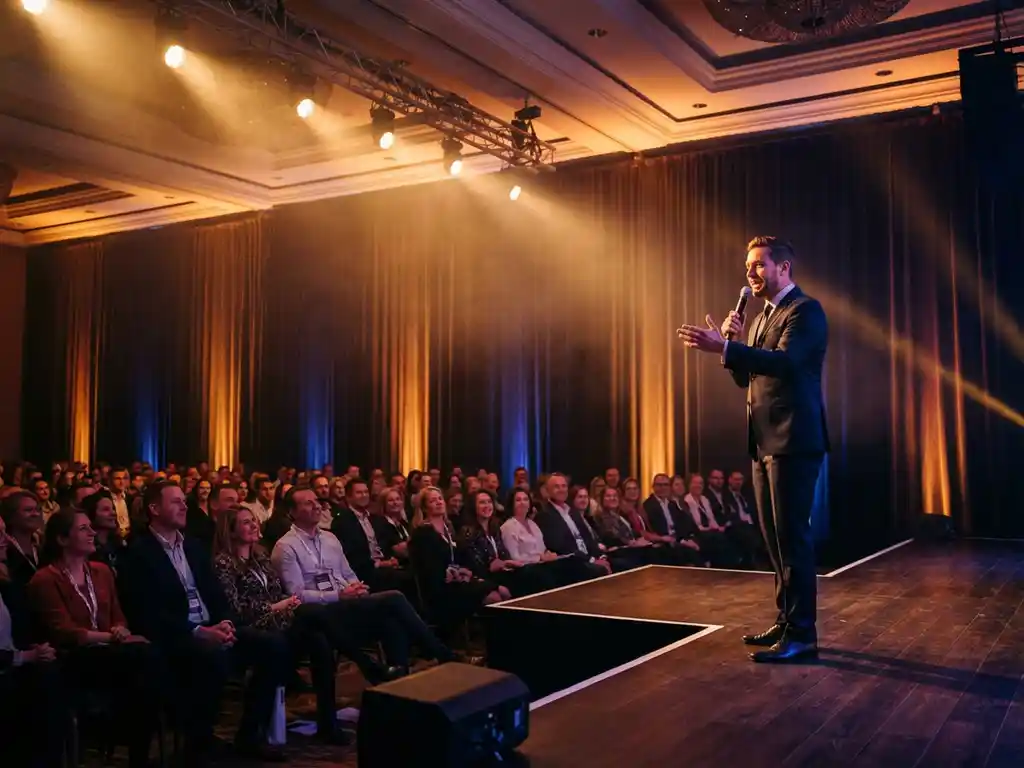
Most people assume a corporate event host is there to say hello at the start and goodbye at the end. In reality, a skilled professional host does far more than simply bookend the agenda. They are the invisible thread that holds an entire event together, shaping how the audience feels, how messages land, and whether people leave energized or exhausted.
Whether you are organizing a company conference, a leadership summit, or a large-scale team event, the quality of your event hosting can make or break the experience. Here are 11 concrete ways a professional corporate event host adds genuine value throughout your program.
What a corporate event host really does
A corporate event host is not simply a presenter who reads from a script. They are a facilitator, an energy manager, a cultural interpreter, and a safety net all rolled into one. Their job is to keep the event moving, the audience engaged, and the overall atmosphere aligned with the goals of the organization.
Think of them as the connective tissue between all the moving parts of your event. Where speakers deliver content and executives share strategy, the host ensures everything flows naturally from one moment to the next. The best hosts are invisible when things go well and invaluable when they do not.
1: Sets the tone before the first speaker talks
The opening minutes of any event are critical. A professional event host steps in before the first speaker takes the stage to establish the atmosphere, manage expectations, and signal to the audience that they are in good hands. This early impression shapes how receptive people will be for the rest of the day.
A skilled host uses this window to warm up the room, introduce the event’s purpose with clarity, and create a sense of shared energy. Getting this right means your first speaker walks into an audience that is already leaning in rather than still settling down.
2: Keeps the energy alive between sessions
The gaps between sessions are where events quietly fall apart. Audiences check their phones, lose focus, or mentally check out entirely. A professional host treats these transitions as active moments rather than dead time, using humor, interaction, or a well-placed observation to keep the momentum going.
This is especially important in longer programs, where attention naturally dips after the first hour. A host who can re-engage the room between sessions ensures that each new speaker or segment starts with a live, attentive audience rather than one that needs to be warmed up all over again.
3: Reads the room and adapts in real time
No event goes exactly as planned, and no two audiences respond the same way. A strong corporate event host continuously reads the energy in the room and adjusts their approach accordingly. If a session runs long and the audience is restless, they know how to pivot. If a topic lands harder than expected, they can shift the tone to give people a moment to breathe.
This kind of real-time adaptability is one of the most underrated skills in event facilitation. It requires experience, emotional intelligence, and genuine comfort in front of an audience. It is not something that can be scripted in advance.
4: Reinforces key messages throughout the event
One of the most powerful things a professional host can do is weave the event’s core themes and key messages throughout the entire program. Rather than leaving it to individual speakers to make the connections, the host acts as a through line, referencing earlier points and building toward the event’s central narrative.
This is particularly valuable for events with a strategic communication goal, such as a company transformation announcement or a leadership summit focused on a specific theme. Repetition of key ideas, when done skillfully, significantly improves retention and alignment across the audience.
5: Makes speakers look and sound their best
A great host does not just introduce speakers; they set them up for success. A well-crafted introduction builds anticipation, establishes credibility, and tells the audience why this person is worth listening to. This matters especially for internal speakers who may not be natural performers.
Equally important is how the host handles the transition after a speaker finishes. Acknowledging key takeaways, bridging to the next segment, and managing applause and timing all contribute to making each speaker’s contribution feel polished and valued.
6: Manages Q&A sessions without awkward silences
Q&A sessions are notoriously unpredictable. Audiences can be slow to engage, questions can go off-topic, or a single participant can dominate the conversation. A professional event MC knows how to manage all of these scenarios with confidence and without making anyone feel uncomfortable.
They keep things moving, rephrase unclear questions, and know when to step in and redirect. When the room goes quiet, they have techniques to spark participation rather than letting an awkward silence drag on and deflate the energy that was carefully built throughout the session.
7: Bridges cultural and language differences
International corporate events bring together people from different backgrounds, communication styles, and cultural norms. A professional host who understands these dynamics can act as a cultural bridge, adjusting humor, pace, and language to make every participant feel included and respected.
This is particularly relevant in the Netherlands, where multinational teams are the norm. A host who can navigate these nuances helps prevent misunderstandings, keeps the tone inclusive, and ensures that no segment of the audience feels alienated by references or humor that do not translate.
8: Handles the unexpected without panic
Technical failures, late speakers, schedule overruns, and unexpected announcements are all part of live event reality. A seasoned conference host has the experience and composure to handle these moments without letting them disrupt the overall experience for the audience.
The ability to improvise confidently in front of a large group is a rare skill. When something goes wrong, the audience takes its cue from the host. A calm, resourceful response keeps trust intact and often goes unnoticed by most of the room.
9: Boosts audience participation and interaction
Passive audiences do not retain information well, and they certainly do not leave events feeling inspired. A skilled event host actively draws the audience into the experience through questions, interactive moments, and activities that make people feel like participants rather than spectators.
This is especially important in hybrid events, where remote participants can easily disengage. A host who knows how to activate both in-room and online audiences creates a more equitable and engaging experience for everyone involved.
10: Reflects and reinforces company culture
Every corporate event is a reflection of the organization that hosts it. The tone, humor, values, and energy that a host brings to the stage should feel consistent with the company’s identity and culture. A misaligned host can create a jarring disconnect that undermines even the most carefully planned program.
When done right, the host becomes an extension of the brand, embodying the values the company wants to project. Whether the culture is bold and creative or measured and professional, the right host amplifies it in a way that feels authentic rather than performative.
11: Turns a good event into a memorable one
Logistics can make an event run smoothly, but they cannot make it unforgettable. That requires human connection, unexpected moments of laughter, and a sense that something genuinely alive happened in the room. A professional host is the person most responsible for creating those moments.
Events that people remember are the ones where they felt something. A great host creates the conditions for those emotional peaks, whether through a perfectly timed joke, a moment of shared recognition, or an interaction that brings the whole room together. These are the moments people talk about long after the agenda has been forgotten.
Why your next event deserves a professional host
Across all 11 points, one thing becomes clear: the role of a corporate event host is far more strategic than most organizations realize. They are not a nice-to-have addition to the program. They are a core driver of whether your event achieves its goals.
Choosing the right host means choosing someone who understands your audience, aligns with your culture, and has the skills to hold the room through every moment of the day. That combination of preparation, adaptability, and genuine stage presence is what separates a forgettable event from one that people actually talk about.
How Boom For Business helps with professional event hosting
At Boom For Business, we bring over 30 years of professional comedy and performance expertise to corporate event hosting and facilitation. Our hosts are not just confident on stage; they are trained in improvisation, storytelling, and reading an audience in real time. That means your event stays alive, on message, and genuinely engaging from the first moment to the last.
Here is what working with us looks like in practice:
- Custom-built programs designed around your event goals, company culture, and audience
- Professional hosts and MCs with real experience in corporate environments and live performance
- Interactive team-building activities that boost participation and create lasting connection among colleagues
- Masterclass workshops in storytelling, communication, and presentation that complement your event content
- Business-friendly humor that keeps energy high without ever feeling out of place in a professional setting
- International experience with multinational teams across the Netherlands and beyond
Whether you are planning a large conference, a leadership summit, or an internal team event, we help you create an experience your audience will actually remember. Visit Boom For Business to explore what we can bring to your next event, discover our Masterclass Workshops and team-building programs, or learn more about how we help organizations build a positive company culture through humor and human connection.
Frequently Asked Questions
How do I choose the right professional host for my corporate event?
Start by looking for a host whose communication style and personality genuinely align with your company culture — a mismatch here can undermine even the best-planned agenda. Ask to see showreels or references from similar corporate events, and ideally have a briefing call to assess how well they listen, ask questions, and understand your goals. The right host will want to know your audience, your key messages, and your desired outcomes before they ever step on stage.
How far in advance should we brief our event host, and what information do they need?
Ideally, you should brief your host at least two to four weeks before the event, with a detailed run-of-show document, speaker bios, key messages, and any cultural or organizational sensitivities they should be aware of. The more context they have — including your company's tone, internal language, and audience background — the more seamlessly they can weave your narrative together on the day. A good host will also request a rehearsal or walk-through, especially for larger or more complex programs.
Can a professional event host also manage a hybrid event with both in-person and remote attendees?
Yes, and this is increasingly one of the most important skills to look for. An experienced host knows how to actively include remote participants by directing questions to the online audience, acknowledging the virtual room, and working with your technical team to ensure transitions feel seamless across both formats. Without deliberate effort from the host, remote attendees tend to disengage quickly — so make sure this is a capability you specifically discuss during your selection process.
What is the difference between a corporate event host and a traditional MC?
A traditional MC typically focuses on introductions, housekeeping announcements, and keeping the schedule on track — essentially a logistical role. A professional corporate event host goes much further, actively shaping the audience's emotional experience, reinforcing key messages, managing energy throughout the day, and adapting in real time to what the room needs. Think of the MC as the timekeeper and the host as the experience architect.
What should we do if our event host has never worked with our industry before?
Industry familiarity is helpful but not essential — what matters more is the host's ability to prepare thoroughly and ask the right questions. Provide them with a solid briefing that includes relevant terminology, your audience's level of expertise, and any topics that are sensitive or off-limits. A skilled professional host will do their own research and come prepared with questions that show they have done their homework, regardless of the sector.
How do we handle it if a session runs over and the host needs to cut time on the fly?
This is exactly the kind of scenario a seasoned host is trained for. Before the event, work with your host to agree on a clear set of signals — such as time cards or a designated point of contact in the production team — so they always know the current status of the schedule. A good host will have pre-planned strategies for gracefully shortening transitions, tightening Q&A sessions, or compressing segments without the audience ever realizing the program has been adjusted.
Is a professional event host worth the investment for smaller internal company events, or is it only necessary for large conferences?
Professional hosting adds value at any scale, because the core challenge — keeping people engaged, on message, and energized — exists whether you have 30 people in a room or 3,000. For smaller events, a skilled host can actually have an even greater impact because there is nowhere to hide; every moment of dead air or awkward transition is felt more acutely. If your event has strategic goals, a professional host is a worthwhile investment regardless of the headcount.
Related Articles
- 7 reasons your team struggles to speak with authority at work and how to fix them
- 9 creativity workshop structures for departments that think they are not creative
- Can event hosts improve internal communication?
- What are video challenge team building formats?
- What are team building solutions for communication overload?