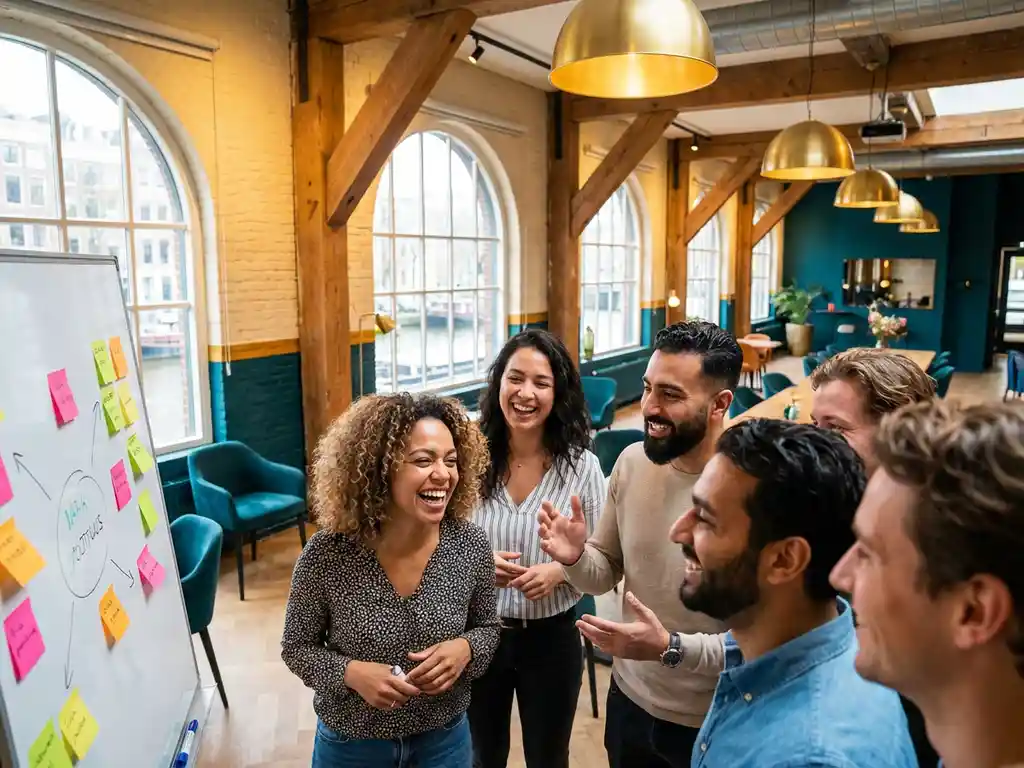
A team-building workshop can be one of the most energizing investments a company makes—or one of the most expensive ways to waste an afternoon. The difference rarely comes down to budget. It comes down to design. When a workshop is built with intention, it creates the kind of shared experience that people carry back into their daily work. When it is not, it becomes a story people tell at the coffee machine for the wrong reasons.
Whether you are planning your first corporate team-building session or looking to improve on past efforts, these eleven qualities consistently separate workshops that create lasting change from those that are forgotten by Monday morning. Use them as a checklist, a planning guide, or a lens for evaluating proposals from facilitators and vendors.
What separates great team building from forgettable workshops
Most forgettable team-building workshops share one common flaw: they are designed around activities rather than outcomes. The games, exercises, and icebreakers become the goal instead of the means to an end. Great team building starts from the opposite direction. It asks what needs to change, what needs to be strengthened, or what needs to be understood—and then builds backward from there.
The eleven qualities below reflect that outcome-first mindset. They apply across industries, group sizes, and formats, whether you are running a half-day workshop in Amsterdam or a multi-day offsite for a global team.
1: Start with a clear and shared purpose
Every successful team-building workshop begins with a clear answer to the question: Why are we here? Not a vague aspiration like “improve communication,” but a specific, honest reason that participants can recognize as relevant to their own work lives. When people understand the purpose from the start, they engage differently. They bring their real experiences to the table instead of going through the motions.
Sharing that purpose openly with participants, rather than keeping it as a facilitator’s backstage agenda, also builds trust. It signals that the workshop respects their time and intelligence, which is the first step toward genuine engagement.
2: Design for energy, not just information
Information transfer is one of the least effective things a workshop can do. People forget the vast majority of what they hear in a passive setting. What they remember is how they felt, what they did, and what surprised them. Designing for energy means thinking about pacing, movement, variety, and emotional engagement alongside any content you want to deliver.
This does not mean filling every minute with activities. It means being intentional about when to introduce energy and when to create space for reflection. The rhythm of a workshop matters as much as its content.
3: Make psychological safety non-negotiable
Psychological safety is the foundation that every other workshop element depends on. When people do not feel safe to speak up, make mistakes, or disagree, the whole experience collapses into performance. Everyone plays it safe, and nothing real gets said or learned.
Creating psychological safety is not just about being nice. It requires deliberate facilitation choices: how the room is set up, how the facilitator responds to early contributions, and whether the norms of the session are made explicit. A workshop that establishes safety early unlocks participation that would otherwise never happen.
4: Use humor as a tool, not just entertainment
Humor in a professional setting is often treated as decoration—something to lighten the mood before getting to the serious stuff. But humor, used well, is one of the most effective tools for building connection, reducing defensiveness, and making ideas stick. It signals that the environment is human, not just transactional.
The key distinction is between humor that includes and humor that excludes. Business-friendly humor invites everyone into the joke rather than making anyone the subject of it. When used with skill, it lowers barriers and makes people more willing to take the creative and interpersonal risks that good team building requires.
5: Involve every participant, not just the loudest
In any group, a handful of people will naturally dominate the conversation. A well-designed workshop does not let that happen unchecked. It builds in structures that give every participant a genuine voice: small-group conversations, written reflection, rotating roles, or activities that require input from everyone before the group can move forward.
This matters both for fairness and for the quality of the outcome. The quietest person in the room often has the most useful perspective. Designing for full participation means those insights actually surface rather than getting drowned out.
6: Tie activities back to real work challenges
Activities that exist in a vacuum, no matter how fun, rarely produce lasting change. The most effective team-building exercises are ones that participants can directly connect to situations they face at work. When someone recognizes a communication pattern from an improv exercise as something that also happens in their weekly team meeting, the learning becomes real and transferable.
This connection does not always happen automatically. Good facilitators make it explicit by asking participants to name the parallel or by framing activities in terms of recognizable workplace dynamics from the start.
7: What does a great facilitator actually do?
A great facilitator does far more than follow a script or manage logistics. They read the room constantly, adjusting pace, tone, and structure in response to what the group actually needs in the moment. They hold space for discomfort without letting it derail the session, and they know when to push and when to let things breathe.
They also stay out of the content. A facilitator’s job is to create the conditions for the group to do its best thinking, not to provide answers. This distinction separates a workshop that empowers a team from one that simply delivers information to them. Experience with improvisation and performance is a genuine advantage here, because it trains facilitators to respond in real time rather than defaulting to a fixed plan.
8: Build in moments of genuine reflection
Reflection is where learning actually consolidates. Without it, even the most engaging activities remain experiences rather than insights. Building structured reflection into a workshop, whether through individual journaling, paired conversation, or a group debrief, gives participants the chance to name what they noticed and decide what they want to do differently.
These moments do not need to be long. Even five minutes of focused reflection after a key activity can dramatically increase the chance that something from the workshop shows up in behavior the following week.
9: Keep group sizes intentional and manageable
Group size has a direct impact on participation, psychological safety, and the quality of conversation. Very large groups tend to produce passive audiences. Very small groups can create pressure that inhibits honest sharing. The sweet spot depends on the objectives, but most effective team-building activities work best in groups of eight to twenty people, with deliberate breakout structures for larger gatherings.
When group sizes are not intentional, the design suffers. Activities that work beautifully with twelve people can fall flat or become chaotic with forty. Planning group size as a design decision rather than an afterthought is a mark of a well-crafted workshop.
10: Set the right environment and atmosphere
Environment shapes behavior in ways that are easy to underestimate. A room full of rows of chairs facing a screen sends a clear message: sit down and receive information. A space configured for movement, conversation, and collaboration sends a completely different message. The physical and social atmosphere of a workshop tells participants what kind of experience they are in before a single word is spoken.
This extends beyond furniture arrangement. Lighting, sound, the presence of food and drink, the way facilitators welcome people as they arrive, and even the choice of venue all contribute to the atmosphere. Getting these details right is not superficial. It is part of the design.
11: Measure what changed after the workshop
A workshop without follow-up measurement is difficult to improve and hard to justify. Measurement does not have to be complex. It can be as simple as asking participants to identify one behavior they intend to change, then following up two weeks later to ask whether they did. What matters is that there is some mechanism for learning whether the workshop achieved its purpose.
Measurement also sends a signal to participants that the organization takes the workshop seriously. When people know there will be follow-up, they engage more intentionally from the start.
Build team building that people actually remember
Designing a team-building workshop that hits all eleven of these marks is not easy, but it is absolutely achievable with the right partner. At Boom For Business, we have spent over 30 years helping organizations create exactly these kinds of experiences, drawing on the improvisation and storytelling expertise of Boom Chicago to bring genuine energy, humor, and human connection into every session.
Our approach to corporate team building and masterclass workshops is built around the principles above. Here is what we bring to every engagement:
- Experienced facilitators trained in improvisation and business communication who read the room and adapt in real time
- Custom-designed programs that connect directly to your team’s real challenges and communication dynamics
- Business-friendly humor that builds psychological safety and makes learning stick
- Structured reflection and practical tools participants can apply immediately after the workshop
- Flexible formats for groups of all sizes, from focused team sessions to large-scale corporate events
Whether you are looking to strengthen collaboration, improve how your team communicates, or simply create a shared experience that brings people closer together, we design workshops that deliver results people feel long after the day is done. Explore our masterclass workshops and team-building programs, discover how we help organizations build a positive culture, or get in touch with us directly to start designing something your team will actually remember.
Frequently Asked Questions
How do I know if my team actually needs a workshop, or if the issues run deeper?
A workshop is most effective when it addresses a specific, identifiable gap—like improving cross-functional communication or rebuilding trust after a period of change. If the underlying issues are structural (such as unclear roles, misaligned leadership, or chronic under-resourcing), a workshop alone will not fix them. A good starting point is to ask: what would be visibly different in how our team works if this workshop succeeds? If you can answer that clearly, a workshop is likely the right tool. If you cannot, it is worth diagnosing the root cause first.
What are the most common mistakes companies make when planning a team-building workshop?
The most frequent mistake is choosing an activity first and defining the purpose second—essentially reverse-engineering a justification for something that looked fun in a brochure. Other common pitfalls include scheduling workshops at the worst possible time (right before a major deadline or at the end of an exhausting quarter), failing to brief participants in advance so they arrive disengaged, and neglecting any form of follow-up after the session. Each of these mistakes undermines even the best-designed content.
How long should a team-building workshop be to actually make a difference?
There is no universal answer, but the most effective workshops tend to be long enough to move past surface-level interaction and short enough to maintain energy throughout. A well-designed half-day session (three to four hours) can produce meaningful results if the objectives are focused and the design is tight. Full-day or multi-day formats allow for deeper work, more reflection, and stronger relationship-building, but only if the additional time is intentionally programmed—not padded with filler. The right length should be driven by your goals, not by what happens to fit the calendar.
How do we get skeptical or disengaged employees to participate genuinely?
Skepticism is almost always a rational response to past experiences with workshops that felt like a waste of time. The most effective way to address it is through transparency: tell people exactly why the workshop is happening, what it is designed to achieve, and how their input will actually be used. Involving employees in the design process—even just asking what they would find valuable—can shift ownership significantly. Once the session begins, a skilled facilitator can turn skeptics into participants by creating early moments of genuine relevance and making it safe to engage without pressure.
What is the best way to measure whether a team-building workshop actually worked?
The simplest and most effective measurement approach ties directly back to the original purpose. Before the workshop, define one or two specific behavioral outcomes you are hoping to see—for example, more open disagreement in team meetings, faster cross-team decision-making, or increased peer feedback. After the workshop, check in with participants and their managers two to four weeks later to ask whether those behaviors have changed. Pulse surveys, short structured conversations, or even a simple follow-up email can all work. The goal is not academic rigor—it is honest learning about whether the investment delivered.
Can team-building workshops work for remote or hybrid teams, or are they only effective in person?
Remote and hybrid workshops absolutely can work, but they require a different design approach—not just a copy-paste of in-person formats onto a video call. The key adjustments include shorter overall session lengths with more frequent breaks, smaller breakout groups to compensate for reduced social cues, more interactive and visual tools (like digital whiteboards or polling), and an even greater emphasis on psychological safety since people tend to be more guarded on camera. When designed with these constraints in mind, virtual team-building can create genuine connection and produce real behavioral change.
How do we choose the right facilitator or vendor for our team-building workshop?
Start by asking any potential facilitator or vendor to explain how they would design a session specifically for your team's challenges—not just describe their standard program. A strong facilitator will ask you more questions than they answer in an initial conversation, because they know that good design starts with deep understanding of the group. Look for evidence of real facilitation experience (not just subject-matter expertise), references from organizations with similar dynamics to yours, and a clear process for customization. Be cautious of vendors who lead with activities rather than outcomes, or who cannot articulate what success looks like after the workshop.