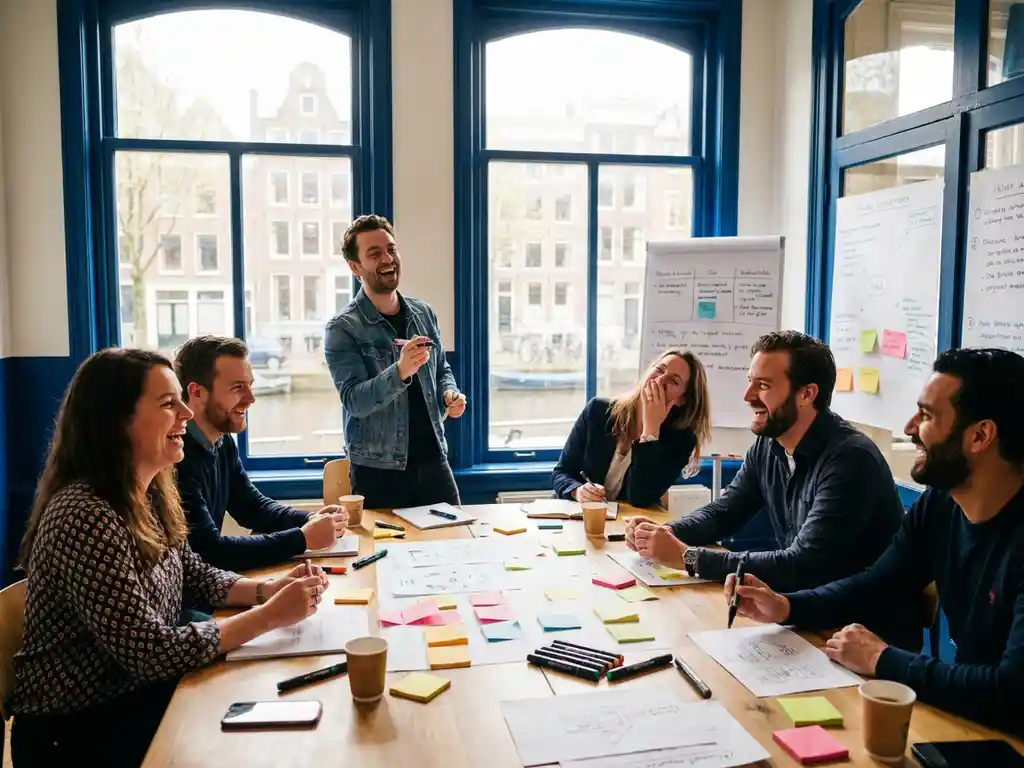
Most teams don’t lack smart people. What they lack is a shared language for thinking differently together. Creative thinking training gives teams exactly that: a practical toolkit for generating better ideas, solving problems from fresh angles, and collaborating in ways that actually stick. The good news is that you don’t need a full innovation lab or a week-long retreat to get started.
The nine exercises below are drawn from proven creative thinking methodologies used in improv, design thinking, and organizational development. Each one is built for real workplace conditions, meaning they work with mixed groups, tight schedules, and varying comfort levels. Pick one to try this week and watch how quickly your team’s creative energy shifts.
Why creative thinking training transforms teams
Creative thinking isn’t a personality trait reserved for artists and inventors. It’s a skill, and like any skill, it improves with deliberate practice. When teams engage in regular creative thinking exercises, they build stronger communication habits, become more comfortable with ambiguity, and develop the kind of psychological safety that makes honest collaboration possible.
The impact goes beyond brainstorming sessions. Teams with stronger creative problem-solving skills tend to communicate more openly, adapt faster to change, and find solutions that more rigid thinking styles miss entirely. These exercises aren’t just fun warm-ups. They’re the foundation of a more innovative, resilient team culture.
1: Yes, and… to build collaborative momentum
Borrowed directly from improv comedy, the “Yes, and…” exercise is one of the most effective creative thinking training tools available. The rule is simple: whenever a colleague offers an idea, you respond by accepting it (“yes”) and building on it (“and”). No rejecting, no redirecting, no “but.”
This exercise dismantles the reflex to evaluate ideas before they’ve had room to breathe. In practice, teams run short rounds where one person starts a scenario and others take turns adding to it. The result is a rapid accumulation of ideas and a team that starts listening to build rather than listening to respond. It’s particularly powerful for teams that tend to shut down ideas early in the process.
2: Reverse brainstorming to unlock fresh ideas
Instead of asking “How do we solve this problem?”, reverse brainstorming flips the question: “How could we make this problem worse?” It sounds counterintuitive, but it works remarkably well for teams stuck in conventional thinking patterns.
Teams generate a list of ways to make the situation as bad as possible, then reverse each item into a potential solution. This approach bypasses the internal editor that kills ideas before they surface. It’s especially useful for workplace creativity challenges where the problem feels too familiar and teams are running out of fresh angles.
3: The 30 circles challenge for rapid ideation
Give every participant a sheet of paper with 30 blank circles printed on it. Set a timer for three minutes. The goal is to turn as many circles as possible into recognizable drawings. It’s fast, slightly silly, and extremely effective at loosening up creative inhibition.
The 30 circles challenge trains teams to prioritize quantity over perfection, which is the exact mindset needed in early-stage ideation. Most people start slowly and then hit a creative flow. In the debrief afterward, you’ll often find that the most interesting ideas emerged in the final minute, when the pressure to be “good” fell away entirely.
4: Random word association for lateral thinking
Choose a random word, completely unrelated to the problem at hand, and ask the team to connect it to their challenge. A word like “lighthouse,” applied to an internal communication problem, might generate ideas around visibility, guidance, or warning signals. The randomness is the point.
This exercise develops lateral thinking by forcing the brain out of its established pathways. It works best in small groups of three to five people and takes less than fifteen minutes. The unexpected connections teams make often lead to genuinely novel approaches that direct brainstorming wouldn’t have surfaced.
5: Worst possible idea to remove creative fear
Ask the team to deliberately generate the worst, most ridiculous ideas they can think of for a given challenge. Celebrate the truly terrible ones. Then, once the laughter settles, examine what made each idea so bad and flip those elements into genuine possibilities.
The worst possible idea exercise works because it removes the social risk of suggesting something that might not land. Once people have competed to be the most wrong, sharing a real idea feels far less daunting. This is one of the most effective team creativity exercises for groups that are hesitant to speak up or take creative risks.
6: SCAMPER method for structured innovation
SCAMPER is an acronym that guides teams through seven creative lenses: Substitute, Combine, Adapt, Modify, Put to other uses, Eliminate, and Reverse. Applied to any existing product, process, or idea, it generates a structured burst of creative alternatives.
Unlike open-ended brainstorming, SCAMPER gives teams a clear framework to work through, which makes it ideal for groups who find completely open ideation overwhelming. It’s particularly effective for innovation training sessions focused on improving existing processes rather than building from scratch. Walk through each letter as a team, applying it to your specific challenge, and you’ll typically surface at least two or three genuinely actionable ideas.
7: Brainwriting to silence the loudest voices
Brainwriting is brainstorming’s quieter, more equitable cousin. Instead of shouting ideas across a table, each person writes their ideas on paper, passes the sheet to the next person, and builds on what they receive. The process continues for several rounds before ideas are shared with the group.
This format ensures that every voice contributes equally, regardless of seniority or personality type. Research in group dynamics consistently shows that verbal brainstorming tends to be dominated by the most extroverted or most senior voices in the room. Brainwriting levels the playing field and often surfaces the most unexpected ideas from the quietest team members.
8: Six thinking hats for multi-perspective analysis
Developed by Edward de Bono, the six thinking hats method assigns different modes of thinking to six colored hats: white for facts, red for emotions, black for caution, yellow for optimism, green for creativity, and blue for process. Teams wear each hat in sequence, ensuring every angle of a problem gets deliberate attention.
This structure prevents the common meeting dynamic where one perspective dominates the discussion. It’s particularly effective for creative problem-solving in complex situations, where decisions carry real organizational weight and multiple viewpoints genuinely matter. Teams that use this method regularly report more balanced discussions and fewer blind spots in their decision-making.
9: Storytelling prompts to connect ideas to impact
Give teams a structured storytelling prompt, such as “Describe a time when a small change made a big difference” or “Tell the story of a problem from the perspective of the person most affected by it.” The goal is to move ideas out of the abstract and into human, relatable territory.
Storytelling is one of the most underused creative thinking skills in professional settings. It helps teams communicate the why behind ideas, build empathy across departments, and make proposals that genuinely land with decision-makers. This exercise works equally well as a warm-up or as a closing reflection, giving teams a way to consolidate what they’ve generated and connect it to real impact.
Make creative thinking a team habit, not a one-off
The biggest mistake teams make with creative thinking exercises is treating them as a one-time event. A single workshop creates a spark. Consistent practice builds a culture. The exercises above are most powerful when they become part of how your team regularly works together, woven into meetings, project kick-offs, and retrospectives rather than reserved for special occasions.
Start small. Pick one exercise and run it at the start of your next team meeting. Notice what shifts. Then build from there, rotating through different methods to keep the creative muscle engaged and prevent the exercises themselves from becoming routine.
How Boom For Business helps with creative thinking training
We bring over 30 years of improv and comedy expertise directly into the workplace through structured, high-energy experiences designed to build exactly the creative thinking skills your team needs. Our Masterclass Workshops are built around the same methodologies that underpin exercises like “Yes, and…”, storytelling, and lateral thinking, translated into corporate-ready formats that work for real teams with real challenges.
Here is what working with us looks like in practice:
- Customized workshop programs tailored to your team’s specific communication or innovation challenges
- Experienced facilitators who understand corporate dynamics and know how to create psychological safety quickly
- Improv-based activities that make creative thinking feel natural rather than forced
- Practical tools participants can apply immediately after the session
- Options for team building experiences that combine creativity with genuine connection
- Programs that support positive organizational culture and lasting behavioral change
If you’re ready to move beyond one-off exercises and build a genuinely creative team culture, we’d love to help you design the right experience. Visit Boom For Business to explore our programs or get in touch to start the conversation.
Frequently Asked Questions
How often should we run creative thinking exercises with our team?
Consistency matters more than frequency. Starting with one short exercise per week, embedded into an existing meeting, is far more effective than a monthly deep-dive session. Even five to ten minutes of structured creative practice at the start of a team meeting builds the habit over time. The goal is to make creative thinking feel like a normal part of how your team works, not a special occasion.
What if some team members are resistant or uncomfortable with these exercises?
Resistance is completely normal, especially in teams that aren't used to this kind of activity. Start with lower-stakes exercises like Brainwriting or Reverse Brainstorming, which don't require anyone to perform or speak up in front of the group. Being transparent about the purpose helps too: frame the exercise as a practical tool for better problem-solving, not a personality test or a team-bonding gimmick. Comfort typically builds quickly once people experience a small win.
Can these exercises work effectively in remote or hybrid team settings?
Yes, most of these exercises translate well to virtual environments with minor adjustments. Brainwriting works seamlessly in a shared Google Doc, the 30 Circles Challenge can be done individually on paper and then debriefed over video, and SCAMPER runs well in a collaborative whiteboard tool like Miro or FigJam. The key is to keep sessions shorter than you would in person, since screen fatigue sets in faster, and to use breakout rooms to replicate the small-group dynamic that makes exercises like Random Word Association most effective.
How do we choose the right exercise for a specific challenge or meeting type?
Match the exercise to the energy and purpose of the moment. For kick-off meetings where you need momentum and buy-in, 'Yes, and…' or the 30 Circles Challenge work well as warm-ups. For structured problem-solving sessions, SCAMPER or Six Thinking Hats provide the framework teams need. If your team is stuck on a familiar problem, Reverse Brainstorming or Random Word Association are your best tools for breaking out of conventional thinking. When psychological safety is the priority, Brainwriting or Worst Possible Idea lower the social risk of contributing.
How long does it typically take before these exercises start producing measurable results?
Most teams notice a shift in meeting energy and idea quality within two to four weeks of consistent practice. The early gains tend to be behavioral: people start building on each other's ideas more naturally, fewer ideas get dismissed prematurely, and quieter team members begin contributing more. Deeper cultural shifts, like increased psychological safety and more open communication across seniority levels, typically emerge after six to eight weeks of regular practice.
What's the most common mistake teams make when running these exercises on their own?
Skipping the debrief is by far the most common mistake. The exercise itself generates energy and ideas, but the debrief is where the real learning happens. Taking five minutes after each exercise to ask 'What did you notice?' or 'What surprised you?' helps teams connect the activity to their actual work and reinforces the behaviors you want to carry forward. Without that reflection step, exercises can feel fun but disposable rather than genuinely transformative.
Do we need a professional facilitator to run these exercises, or can a team leader do it?
Many of these exercises are designed to be run by a team leader or internal champion without specialist facilitation training. The instructions are straightforward, and the structure of each exercise does most of the heavy lifting. That said, a professional facilitator adds significant value when psychological safety is low, when teams are working through a high-stakes challenge, or when you want to combine multiple methodologies into a cohesive workshop experience. For ongoing culture change rather than one-off sessions, external facilitation tends to accelerate results considerably.
Related Articles
- 11 employee engagement workshop ideas that go beyond the usual activities
- What preparation does an event host need before your event?
- What should a B2B teambuilding workshop include to deliver measurable results?
- How do team building activities reduce information overload?
- What is the difference between a fun team building activity and a meaningful one?