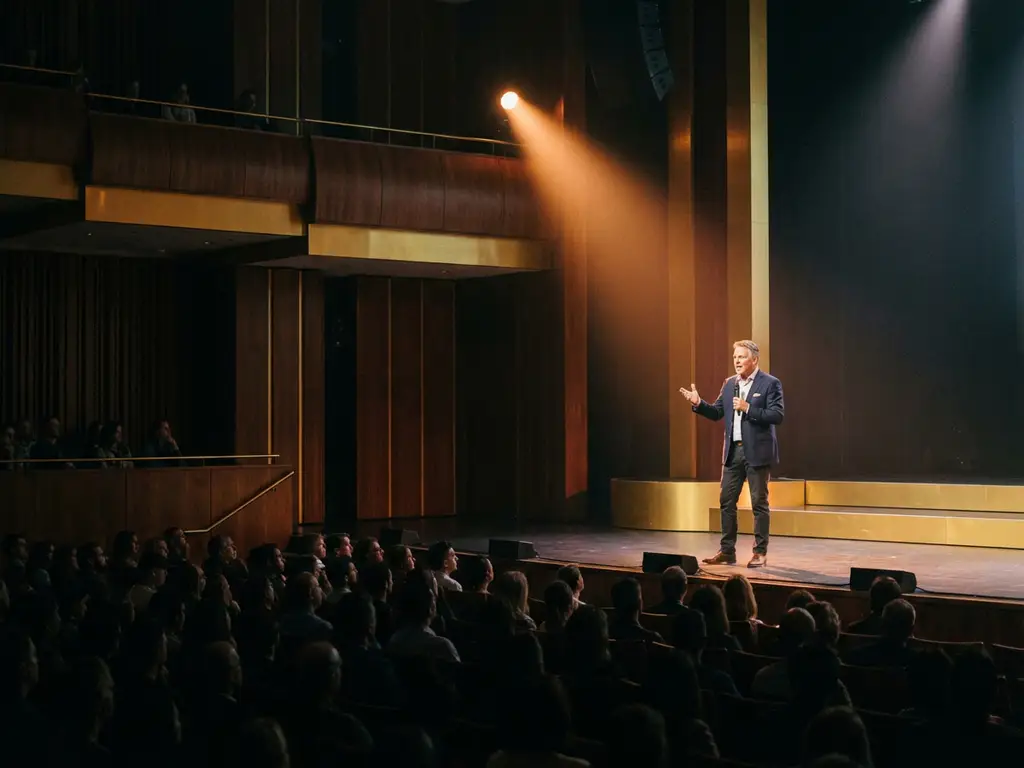
A corporate event lives or dies by the person holding the microphone. You can have a flawless venue, a compelling agenda, and a room full of engaged professionals, but without the right host steering the experience, even the best-planned event can fall flat. The role of a corporate event host goes far beyond reading from a script or filling time between speakers.
Whether you are organizing a company-wide conference, a product launch, or a team-building day in Amsterdam, understanding what separates a competent MC from a truly exceptional one helps you make smarter decisions for your next event. Here are nine corporate event host skills that genuinely make the difference when it counts.
What separates a good host from a great one
A good host keeps things running on time. A great host makes the audience feel like they are part of something worth remembering. The difference comes down to a specific set of skills that go well beyond stage presence or a confident speaking voice. Professional event hosting is an active, responsive craft that demands preparation, emotional intelligence, and real-time adaptability.
The skills listed below are not abstract qualities. They are observable, learnable, and directly connected to the outcomes your event is designed to achieve. Whether you are briefing a corporate event MC for the first time or evaluating your existing approach, these are the benchmarks worth holding on to.
1: Reading the room before it fills up
The best hosts do their homework before a single guest walks through the door. This means understanding the audience demographics, the organizational culture, the purpose of the event, and any sensitivities that might affect tone or content. A host who walks in cold and improvises from scratch is taking an unnecessary risk.
Strong preparation allows a host to calibrate their energy, language, and humor to match the specific group in the room. An audience of senior executives at a strategy day needs a different approach than a cross-functional team at a culture workshop. Reading the room starts long before the event does.
2: Commanding attention from the first minute
The opening moments of any corporate event set the tone for everything that follows. A skilled host does not ease gently into the proceedings. They establish presence, create momentum, and signal to the audience that their time and attention are in good hands. This is one of the most critical event host skills because first impressions are nearly impossible to reverse.
This does not mean being loud or theatrical for its own sake. It means being purposeful, clear, and energizing from the first sentence. A strong opening creates psychological permission for the audience to relax and engage rather than stay guarded or distracted.
3: Keeping energy levels consistent throughout
Long corporate events present a specific challenge: energy naturally dips after lunch, after dense content blocks, and during transitions between speakers. A professional host actively manages these rhythms rather than letting the event drift into passive attendance.
Consistent energy does not mean constant high intensity. It means knowing when to slow down for reflection, when to inject momentum, and when to give the audience a moment to breathe. A host who understands pacing keeps the experience feeling alive from the first session to the final close.
4: Handling the unexpected without losing composure
Technical failures, late speakers, awkward silences, and off-script moments are not exceptions in live event management. They are part of reality. What distinguishes an experienced corporate event MC is the ability to navigate these moments without letting the audience feel the friction.
Composure under pressure is a skill built through experience and, importantly, through improvisation training. A host who can fill a gap with genuine wit, redirect attention gracefully, or acknowledge a problem without amplifying it keeps the event on track and the audience trusting the process.
5: Using humor that lands with every audience
Humor is one of the most powerful tools in professional event hosting, and also one of the most misused. The goal is never to perform comedy at the expense of the audience or the content. The goal is to use well-placed, business-friendly humor to reduce tension, create connection, and make information more memorable.
Effective event humor is inclusive, contextually aware, and purposeful. A skilled host knows how to get a genuine laugh from a room of 200 professionals without alienating anyone or undermining the seriousness of the content. This takes craft, not just confidence.
6: Bridging content and keeping transitions smooth
One of the most underrated event hosting skills is the ability to connect different parts of a program into a coherent whole. When a host simply announces the next speaker or reads a name from a card, the event feels like a series of disconnected segments. When a host bridges content thoughtfully, the event feels like a journey with intention.
Good transitions summarize what just happened, frame what comes next, and maintain the narrative thread of the event. This keeps audiences oriented and reinforces the core messages the event is designed to deliver.
7: Making audience interaction feel natural
Forced participation is one of the fastest ways to lose an audience. Asking people to raise their hands, shout out answers, or turn to a neighbor can feel awkward if the host has not built sufficient rapport or created the right conditions for engagement. A skilled host makes interaction feel like a natural extension of the conversation rather than an exercise.
This requires reading the audience’s comfort level in real time and calibrating accordingly. The best hosts create micro-moments of engagement throughout the event so that when larger interactive elements arrive, the audience is already warmed up and willing.
8: Staying sharp under pressure and on camera
Hybrid and streamed corporate events have added a new layer of complexity to professional event hosting. A host now needs to manage a live room and a virtual audience simultaneously, while staying present and responsive to both. This demands a specific kind of focus that not every presenter naturally possesses.
On-camera presence, clear diction, and the ability to maintain energy without live audience feedback are distinct skills. Hosts who have experience in both live and recorded formats bring a significant advantage to events that need to land across multiple channels at once.
9: Knowing the brand and speaking its language
A corporate event host represents the organization to its own people. That means understanding the company’s values, tone, strategic priorities, and internal culture well enough to speak authentically on its behalf. A host who uses the wrong terminology, misrepresents a key initiative, or contradicts the company’s messaging can undermine trust quickly.
The best hosts invest time in a proper briefing process, ask the right questions, and treat brand alignment as a non-negotiable part of their preparation. This is what allows them to feel like a genuine extension of the team rather than an outside contractor reading from notes.
How the right host transforms your next event
Each of the skills above contributes to something larger: an event experience where the audience feels genuinely engaged, the content lands with impact, and the organization’s message is reinforced rather than diluted. The right corporate event host does not just manage logistics. They shape how people feel about the day, the company, and each other.
How Boom For Business helps with professional event hosting
We bring over 30 years of professional hosting, comedy, and improvisation expertise to corporate events across Amsterdam and beyond. Rooted in the internationally acclaimed Boom Chicago theater, our approach combines genuine entertainment skill with deep corporate experience. Here is what we offer:
- Experienced corporate event hosts and MCs who prepare thoroughly, adapt in real time, and keep your audience engaged from start to finish
- Custom-built programs tailored to your brand, culture, and communication goals, so every transition and interaction feels intentional
- Business-friendly humor that creates connection without risk, drawing on decades of experience reading diverse professional audiences
- Masterclass workshops in storytelling, presentation, and communication for teams who want to build these skills internally
- Team-building experiences and positive culture programs that extend the impact of your event beyond the day itself
Whether you are planning a company conference, a leadership summit, or a team-building day, we help you create an experience your audience will actually remember. Explore what Boom For Business can do for your next event, discover our Masterclass Workshops for teams, check out our team-building programs, or learn more about how we support positive culture initiatives within your organization. Get in touch and let us help you make it count.
Frequently Asked Questions
How do I brief a corporate event host effectively before the event?
A thorough briefing should cover your event's purpose, audience demographics, company values, key messages, agenda flow, and any sensitivities around topics or terminology. Share internal language, strategic priorities, and context about recent company developments so the host can speak authentically on your behalf. The more specific you are upfront, the less room there is for misalignment on the day itself.
What is the difference between a corporate event MC and a keynote speaker?
A keynote speaker delivers a defined piece of content to the audience, while a corporate event MC owns the entire experience — managing flow, energy, transitions, audience engagement, and unexpected moments throughout the full program. The MC is the connective tissue of your event, whereas a keynote speaker is one component within it. For longer or more complex events, having a dedicated host rather than relying on a speaker to double as MC is almost always the stronger choice.
How far in advance should we book a professional event host?
For major corporate events such as conferences, product launches, or leadership summits, booking four to eight weeks in advance is a reasonable minimum, though popular hosts can be booked out much further. Earlier booking also gives you more time for a proper briefing and preparation process, which directly impacts the quality of the hosting on the day. Last-minute bookings are possible but limit your options and reduce the preparation time that makes a real difference.
Can the same host work for both in-person and hybrid or virtual events?
Not automatically — on-camera presence, managing a virtual audience, and maintaining energy without live crowd feedback are distinct skills that not every experienced live host has developed. When evaluating a host for a hybrid or streamed event, ask specifically about their experience in both formats and whether they are comfortable managing a live room and a digital audience simultaneously. The best hosts for hybrid events have a background in both live performance and recorded or broadcast environments.
What are the most common mistakes companies make when choosing a corporate event host?
The most frequent mistake is prioritizing name recognition or internal seniority over actual hosting skill — choosing a well-known executive or industry figure to MC an event simply because of their status, rather than their ability to read a room, manage energy, and handle the unexpected. Another common error is underinvesting in the briefing process, leaving the host underprepared on brand language and audience context. A skilled professional host with proper preparation will almost always outperform an impressive but unprepared internal choice.
How do I know if a host's humor style is appropriate for our company culture?
Ask to see recorded footage from previous corporate events, ideally with audiences similar to yours in size, industry, or seniority level. Pay attention to whether the humor is inclusive and contextually aware, or whether it relies on edgy material, self-deprecation at the audience's expense, or anything that could alienate a professional crowd. A reputable corporate host should also be open to discussing boundaries and content guidelines during the briefing so you can align on tone before the event.
Is it worth hiring a professional host for smaller internal events, or just for large conferences?
Professional hosting adds value at any scale where audience engagement and message retention matter — which includes smaller town halls, team days, and internal workshops, not just large-scale conferences. In fact, smaller events can suffer more visibly from poor hosting because there is less spectacle to compensate for a flat or disorganized experience. If the goal is for people to leave feeling energized, aligned, or connected, a skilled host is a worthwhile investment regardless of headcount.
Related Articles
- How do you create team building activities that resonate with employees?
- How do improvisation skills transfer to workplace communication?
- How do you combine learning with fun in team building?
- How do improvisation exercises build workplace confidence?
- What are the benefits of hiring Amsterdam-based event hosts?