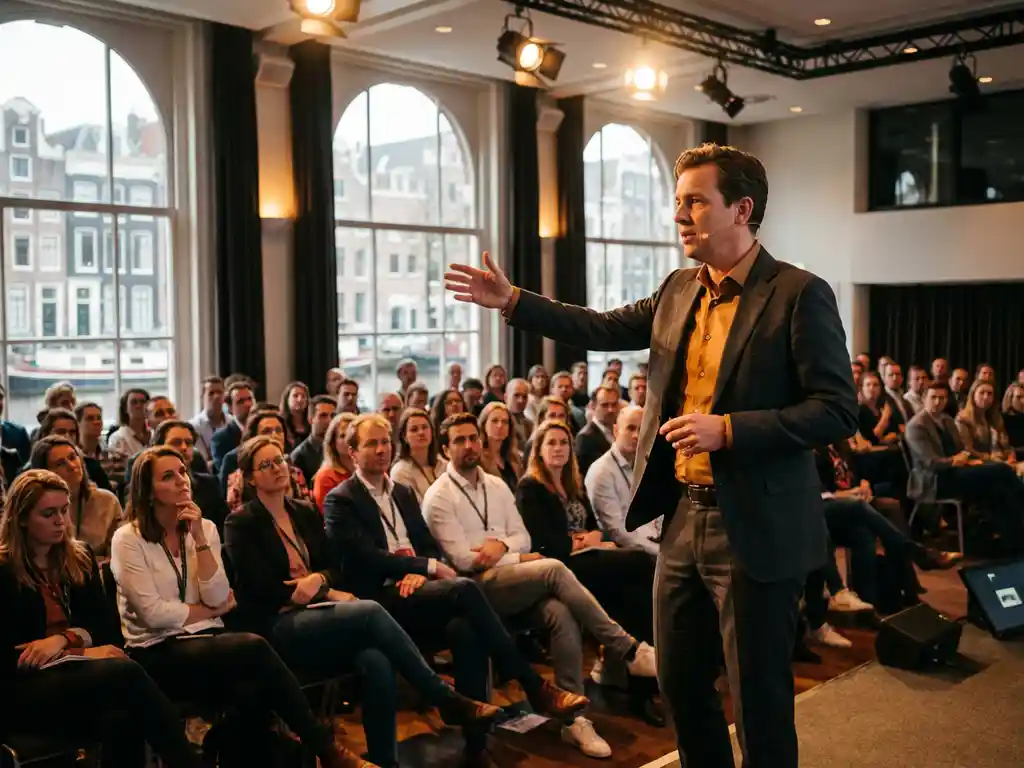
Keeping a room engaged for a full-day corporate event is one of the hardest challenges any event presenter faces. Attention spans are short, calendars are packed, and by mid-afternoon, even the most motivated audiences start drifting. The difference between a forgettable day and one people talk about weeks later often comes down to technique, not topic.
Whether you are hosting a company-wide conference, a leadership summit, or a strategic offsite, these event presenter techniques will help you hold attention, build energy, and deliver messages that actually land. Each tip below is practical, actionable, and tested in real corporate environments.
Why full-day events lose the room (and how to fix it)
Most full-day events lose their audience not because the content is bad, but because the format is predictable. Slide after slide, speaker after speaker, with no variation in pace or format, trains the brain to switch off. When people feel passive, they become passive.
The fix is not to entertain people into submission. It is to design the experience so engagement is built into the structure itself. The following techniques address the most common energy leaks in a full-day program and give you concrete tools to keep audience engagement high from opening to close.
1: Open with a hook that earns attention fast
The first 60 seconds of any presentation set the tone for everything that follows. A strong opening does not start with housekeeping, a long introduction, or a slide full of objectives. It starts with something that makes the audience lean in.
A provocative question, a surprising fact, a short story, or even a moment of unexpected humor can establish presence and signal to the room that this will be different. As a corporate event presenter, your job in the opening is to earn attention, not assume it.
2: Break the 20-minute attention wall
Research in cognitive science consistently shows that sustained focus drops significantly after around 20 minutes of passive listening. This is not a weakness in your audience. It is how human attention works.
Build deliberate pattern interrupts into your program every 15 to 20 minutes. This could be a short activity, a discussion prompt, a change in speaker, or simply a shift in delivery style. The goal is to reset the brain before it fully disengages, not after.
3: Use physical movement to reset energy levels
Sitting still for hours is physically draining, and a tired body produces a tired mind. One of the most underused audience engagement techniques is simply getting people out of their chairs.
This does not need to be elaborate. A quick stand-and-discuss exercise, a short walk to a different part of the room, or a standing brainstorm can dramatically reset the energy in the space. Movement increases blood flow, sharpens focus, and signals a transition that helps people re-engage with the content.
4: Ask questions that demand real responses
Rhetorical questions are easy to ignore. Questions that require a genuine response—whether spoken, written, or voted on—pull people back into active participation. The key is specificity. “What do you think?” invites disengagement. “Which of these two approaches would you actually use with your team, and why?” demands a real answer.
Polling tools, raised hands, sticky notes, and small group discussions all work well. What matters is that the question feels relevant and the answer feels valued. When people know their input shapes the room, they stay present.
5: Read the room and adapt in real time
The best conference presenter tips all share one thing: flexibility. A rigid presenter who sticks to the script regardless of the room’s energy will lose the audience even with excellent content. Reading the room means noticing when energy drops, when confusion appears, or when a topic generates unexpected interest.
Adapt accordingly. Slow down when you sense confusion. Speed up when you sense restlessness. Lean into a moment of genuine laughter or curiosity rather than pushing it aside to stay on schedule. Responsiveness builds trust and keeps the experience feeling alive.
6: Anchor key messages with storytelling
Data and bullet points inform. Stories stick. When you anchor a key message in a concrete, relatable narrative, you give the audience something their memory can hold onto long after the event ends.
Effective storytelling does not require drama. A short example of a real challenge, a moment of failure and recovery, or a vivid scenario that mirrors the audience’s own experience is enough. The story should serve the message, not overshadow it. One well-chosen story per major message is a reliable rule of thumb.
7: Use humor strategically, not randomly
Humor is one of the most powerful tools in a presenter’s toolkit, but only when it is intentional. Random jokes that feel disconnected from the content create awkwardness rather than connection. Strategic humor, placed at moments of tension or transition, releases pressure and builds rapport.
The goal is not to be a comedian. It is to use lightness to make the content more accessible and the room more receptive. Self-aware humor, observations about shared experiences, and playful framing of difficult topics all work well in corporate settings without undermining credibility.
8: Design interaction into the program structure
Interaction added as an afterthought feels forced. Interaction designed into the program from the start feels natural and purposeful. When you build your full-day event agenda, map out where the audience will speak, move, collaborate, and contribute before you finalize any content block.
This might include structured small group discussions, live problem-solving exercises, peer feedback rounds, or collaborative challenges. The format matters less than the principle: people engage more deeply when they are active contributors to the experience rather than passive recipients of it.
9: Manage energy with intentional pacing
A full-day program is a marathon, not a sprint, and pacing it well is one of the most important event hosting tips you can apply. High-energy sessions need to be followed by lower-intensity moments. Complex cognitive content should not be scheduled immediately after lunch, when energy naturally dips.
Think of the day as having an energy arc. Plan your most demanding sessions for mid-morning, when focus is sharpest. Use post-lunch slots for interactive, movement-based activities that counteract the natural afternoon slump. End the day with something energizing rather than something heavy.
10: Personalize content to the specific audience
Generic content is the fastest route to a disengaged room. When people feel that the program was designed specifically for them, their organization, and their challenges, they invest more attention in it. Personalization does not require a complete rewrite for every event.
Reference the company’s actual context, use language familiar to the industry, and acknowledge the specific pressures or goals the audience is navigating. Even small touches, like using the team’s own terminology or referencing a recent company milestone, signal that the presenter has done the work to understand who is in the room.
11: Close with energy, not a summary slide
The final impression of a full-day program is as important as the first. A closing that trails off into a list of recap bullet points leaves the room feeling flat. A strong close leaves people energized, clear on next steps, and genuinely glad they were there.
Consider closing with a forward-looking challenge, a memorable call to action, or a moment of shared reflection that connects the day’s content to something meaningful. Give the audience something to carry out of the room, not just a reminder of what they already heard.
What separates a good presenter from an unforgettable one
Good presenters deliver information clearly. Unforgettable presenters create experiences that change how people think, feel, or act. The techniques above are not tricks. They are the building blocks of a presenter who genuinely connects with an audience and holds that connection throughout a long, demanding day.
The most consistent differentiator is presence: the ability to stay responsive, curious, and genuinely engaged with the room rather than focused solely on delivering the material. When an audience feels that a presenter is truly with them, they stay with the presenter.
How Boom For Business helps you master event presenter techniques
Applying these techniques consistently takes practice, feedback, and a solid foundation in communication craft. That is exactly where we come in. At Boom For Business, we draw on over 30 years of expertise from Boom Chicago to help professionals and teams build the skills that make the difference between a forgettable event and one that genuinely moves people.
- Our Masterclass Workshops cover presentation delivery, storytelling, strategic humor, and audience engagement, using improvisation-based methods that make the learning stick.
- We work with organizations across the Netherlands and internationally to design and host full-day events that keep energy high from the first session to the final close.
- Our facilitators are experienced in reading corporate rooms and adapting in real time, modeling the very techniques described in this article.
- Programs are fully customized to your audience, your content, and your organizational context, so nothing feels generic.
- Our team building experiences and positive culture programs complement event hosting by building the communication and collaboration foundations that make every event more impactful.
If you are planning a corporate event and want a partner who brings both professional expertise and genuine energy to the room, get in touch with us at Boom For Business and let us help you create an experience your audience will not forget.
Frequently Asked Questions
How do I handle an audience that is visibly disengaged despite using these techniques?
First, name it — briefly and without blame. Saying something like 'I can feel the afternoon energy in the room, so let's shift gears' acknowledges reality and gives you permission to pivot. From there, introduce an unplanned movement break, switch to a small group discussion, or ask a high-stakes question that makes the content feel immediately relevant. The worst response to a disengaged room is to push harder through the same format that caused the disengagement.
What is the ideal ratio of presentation to interaction in a full-day corporate event?
A practical benchmark is no more than 20 minutes of passive content delivery before introducing an interactive element of some kind. Across a full day, aim for roughly a 60/40 split between presenter-led content and active audience participation — including discussions, exercises, polls, and movement breaks. This ratio will shift depending on your audience and objectives, but erring toward more interaction rather than less is almost always the right call.
How can I use these techniques if I am not the main presenter but a session facilitator or panel moderator?
Most of these techniques translate directly to facilitation and moderation roles. As a moderator, you control pacing, question quality, and energy transitions — all of which are covered above. Focus especially on asking specific, high-stakes questions (Tip 4), reading the room in real time (Tip 5), and managing the energy arc across your session (Tip 9). Your role gives you significant influence over audience engagement even when others are doing the talking.
What are the most common mistakes presenters make when trying to add humor to a corporate event?
The most frequent mistake is using humor that only lands for part of the room — jokes that rely on insider knowledge, cultural references, or humor that could alienate rather than include. A close second is forcing humor at moments that do not call for it, which creates awkwardness instead of connection. Stick to observational humor about shared experiences, self-aware moments, or playful reframing of content — these styles are inclusive, low-risk, and genuinely effective in corporate settings.
How far in advance should I start designing the interaction elements for a full-day event?
Interaction should be mapped into the program structure at the same time as the content — not added afterward as a polish step. Ideally, you are designing both simultaneously from the very first planning session. This ensures that interactive moments feel purposeful and integrated rather than bolted on. Leaving interaction design to the week before the event is one of the most reliable ways to end up with activities that feel forced or disconnected from the material.
Can these techniques work for virtual or hybrid corporate events, or are they only effective in person?
The core principles apply to any format, but the execution needs to be adapted for virtual and hybrid contexts. Pattern interrupts, specific questions, storytelling, and intentional pacing are all format-agnostic. For virtual events, lean heavily on polling tools, breakout rooms, and chat-based interaction to replace physical movement and in-room discussion. Hybrid events require extra care to ensure remote participants feel as engaged and included as those in the room — which often means designing interaction specifically for both groups rather than defaulting to the in-person experience.
How do I convince internal stakeholders to approve a more interactive event format when they are used to traditional conference-style programs?
Frame the case around outcomes, not format preferences. Stakeholders who push back on interactive design are usually worried about professionalism, time efficiency, or loss of control — not interaction itself. Show them how structured engagement directly improves message retention, participant satisfaction scores, and post-event behavior change. If possible, reference a previous event where energy dropped or feedback was flat, and position the new approach as a deliberate fix with a clear rationale behind each design choice.
Related Articles
- How do you create team building activities that resonate with employees?
- What is the ROI of professional event hosting services?
- 9 team workshops that HR professionals recommend in 2026
- What are entertainment-focused team building programs?
- How do event hosts improve employee engagement at corporate gatherings?