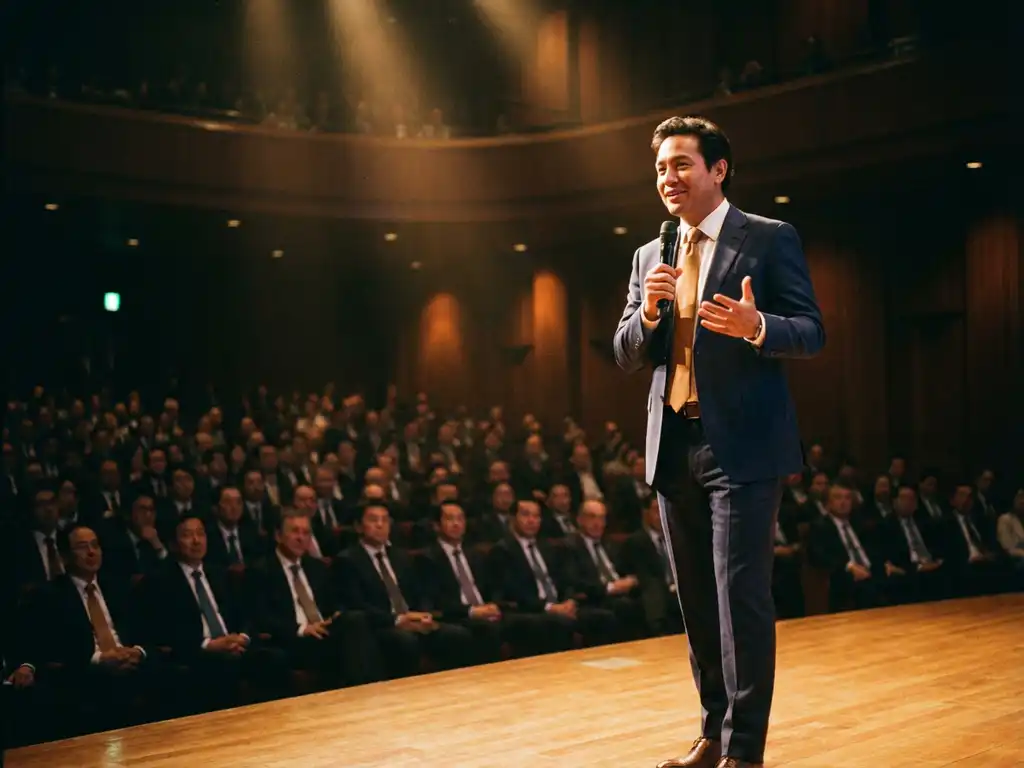
The presenter standing at the front of your company event shapes everything. From the first welcome to the final call to action, how your event is hosted determines whether your audience leaves energized and aligned—or quietly relieved it’s over. Many organizations default to asking an internal team member to step into the hosting role, and while the intention is good, the result rarely matches what a professional event presenter delivers.
The difference isn’t simply about confidence or public speaking experience. It runs deeper than that. Professional hosts bring a specific set of skills developed over years of live performance, corporate event hosting, and audience psychology—skills internal staff simply can’t replicate on the day. Here are seven of those skills, and why they matter for your next company event.
Why your presenter choice defines the whole event
Your presenter is not just a logistical necessity. They are the emotional anchor of the entire experience. Every transition, every moment of silence, every audience reaction passes through them. When that role is filled by someone who is also managing their own nerves, their own job responsibilities, and their own relationships with colleagues in the room, the quality of the event suffers before a single slide is shown.
A professional event MC brings neutrality, energy, and expertise that frees your team to focus on content and participation. The return on that investment shows up in engagement levels, audience mood, and the lasting impression your event creates.
1: Reading the room in real time
A skilled professional host reads audience energy continuously and adjusts accordingly. They notice when attention dips, when a topic lands harder than expected, or when the room needs a moment of levity before moving forward. This is not instinct alone. It is a trained capability built through hundreds of live events.
Internal presenters are often too close to the content or too aware of internal politics to read the room objectively. A professional event presenter has no stake in organizational dynamics, which gives them the clarity to respond to what is actually happening in front of them rather than what they hope or fear is happening.
2: Turning awkward silence into momentum
Silence during a corporate event can feel catastrophic to an internal host. A professional knows how to use it. Whether a Q&A falls flat, a technical issue creates a pause, or an audience question goes unanswered, an experienced event MC transforms that moment into connection rather than awkwardness.
This skill is particularly valuable during panel discussions, interactive sessions, and live audience participation formats. The ability to hold a room comfortably during an unscripted moment is one of the clearest separators between a professional host and a well-meaning colleague pressed into service.
3: Commanding attention without authority
Internal presenters often rely on their organizational seniority to hold attention. A professional event presenter has none of that positional authority, which means they have developed genuine stage presence instead. They earn attention through energy, timing, humor, and connection rather than hierarchy.
This matters enormously in mixed audiences where not everyone reports to the same leadership structure, and in employee engagement events where people may be skeptical or fatigued. A professional host commands the room because the room wants to listen, not because they feel obligated to.
4: Making complex messages land with clarity
Corporate events frequently carry strategic messages that leadership wants employees to understand, remember, and act on. Translating dense organizational content into something that genuinely resonates with a live audience requires storytelling skill, not just good slides.
A professional event presenter works with your content before the event to understand the core message, then uses narrative techniques and business-friendly humor to make that message memorable. They know how to frame information so it sticks, which is the difference between a message that lands and one that disappears the moment the event ends.
5: Creating psychological safety for participation
Interactive sessions, workshops, and Q&A formats only work when the audience feels safe enough to contribute. That psychological safety does not happen automatically. It is built deliberately through tone, humor, and the way a host responds to the first few audience contributions.
A professional host knows how to create an environment where participation feels rewarding rather than risky. They use warmth, wit, and genuine acknowledgment to lower the social stakes of speaking up. Internal presenters often struggle here because their colleagues are watching, which creates a dynamic where both host and audience are performing for each other rather than genuinely connecting.
6: Holding energy across a full-day program
A single presentation is one thing. Hosting a full-day conference, leadership summit, or team-building event is something else entirely. Energy management across multiple hours, multiple speakers, and multiple formats requires professional stamina and deliberate pacing.
Professional event hosts plan energy arcs across a full program. They know when to accelerate, when to slow down, and how to re-engage an audience after lunch or a long workshop block. Internal staff asked to host for an entire day are typically exhausted by mid-morning from the combination of performance pressure and their own professional responsibilities.
7: Staying fully present while managing logistics
Great hosting looks effortless because the host is entirely focused on the audience. Behind that effortlessness is constant awareness of timing, speaker transitions, technical cues, and program flow. A professional event presenter manages all of this while appearing completely relaxed and present.
Internal hosts are almost always split between the hosting role and their own anxiety about whether everything is going according to plan. That split attention is visible to the audience, even when the host is not aware of it. A professional has developed the capacity to hold both dimensions simultaneously without either suffering.
How Boom For Business helps you host events that actually work
At Boom For Business, we bring over 30 years of live performance and corporate event expertise to every hosting engagement. Rooted in the internationally acclaimed Boom Chicago comedy theater, we combine professional presentation skills with genuine humor and audience intelligence to make your events land the way you intend them to.
Here is what working with us looks like in practice:
- Custom program design tailored to your event goals, audience, and organizational culture
- Professional event hosting and MC services that keep energy high from opening to close
- Interactive formats that build psychological safety and drive genuine participation
- Masterclass workshops that develop your team’s storytelling and presentation skills for the long term
- Business-friendly humor that makes complex messages memorable without losing professionalism
- Experience across international corporate environments, including company events in Amsterdam and beyond
Whether you are planning a leadership summit, a team-building day, or a large-scale internal communication event, we are here to make it genuinely engaging. Explore our full range of corporate event services, discover our Masterclass Workshops, or find out how our team-building programs and positive culture initiatives can support your organization. Let us show you what the right presenter makes possible.
Frequently Asked Questions
How far in advance should we book a professional event presenter for our company event?
For most corporate events, booking a professional event presenter at least 6–8 weeks in advance is ideal. This gives the host enough time to understand your program structure, organizational culture, and key messages before the event day. For large-scale conferences or leadership summits, booking 3–6 months ahead ensures you secure the right fit and allows for thorough pre-event preparation and collaboration.
What information does a professional event MC need from us before the event?
A professional event MC typically needs a clear brief covering your event goals, audience profile, program agenda, key messages leadership wants to land, and any sensitive topics or internal dynamics to be aware of. The more context you provide upfront—including your company culture and the tone you want to set—the better they can tailor their hosting style to feel like a natural extension of your brand rather than a generic outsider.
Can a professional host really adapt to our company's specific culture and industry?
Yes, and this is a core part of what separates experienced corporate event hosts from general public speakers. A seasoned professional event presenter invests time before the event to understand your industry language, organizational values, and audience expectations. They use this preparation to make their presence feel relevant and credible, not generic—so your audience experiences someone who clearly understands their world, not someone reading from a script.
What if our internal presenter is already confident and experienced with public speaking—do we still need a professional?
Confidence and public speaking experience are valuable, but they don't fully replicate what a professional event host brings to a corporate setting. Internal presenters—no matter how skilled—are still navigating their own organizational relationships, performance anxiety, and split attention between hosting and their day-to-day role. A professional host's value lies in their neutrality, trained audience management, and ability to stay fully present throughout the entire event, which is difficult for even the most capable internal colleague to match.
How do professional event hosts handle unexpected situations, like a speaker dropping out or a technical failure?
Handling the unexpected is one of the most critical skills a professional event presenter develops over years of live events. Whether a speaker cancels last minute, a microphone cuts out, or an audience Q&A goes in an unplanned direction, a seasoned MC has a toolkit of techniques to fill the gap seamlessly—keeping the audience engaged and the energy intact. Their ability to improvise professionally means your attendees rarely notice when something has gone off-script.
Is a professional event MC a good fit for smaller internal meetings, or only large-scale events?
Professional hosting adds value across event sizes, though the format and investment level naturally scale accordingly. For smaller internal meetings or team workshops, a professional host can be especially impactful because the stakes of awkward silences, low participation, or flat energy are actually higher in intimate settings. Even a half-day internal workshop benefits significantly from someone whose sole focus is keeping the room energized and the objectives on track.
How can we measure the impact of using a professional event presenter versus an internal host?
The clearest indicators are post-event survey scores on engagement, energy, and message retention—metrics that tend to rise noticeably when a professional host is involved. Beyond surveys, watch for qualitative signals: how quickly people re-engage after breaks, the volume and quality of audience participation during interactive sessions, and whether the key messages from leadership are still being referenced in team conversations days after the event. These outcomes reflect the lasting impression a skilled professional event presenter creates.