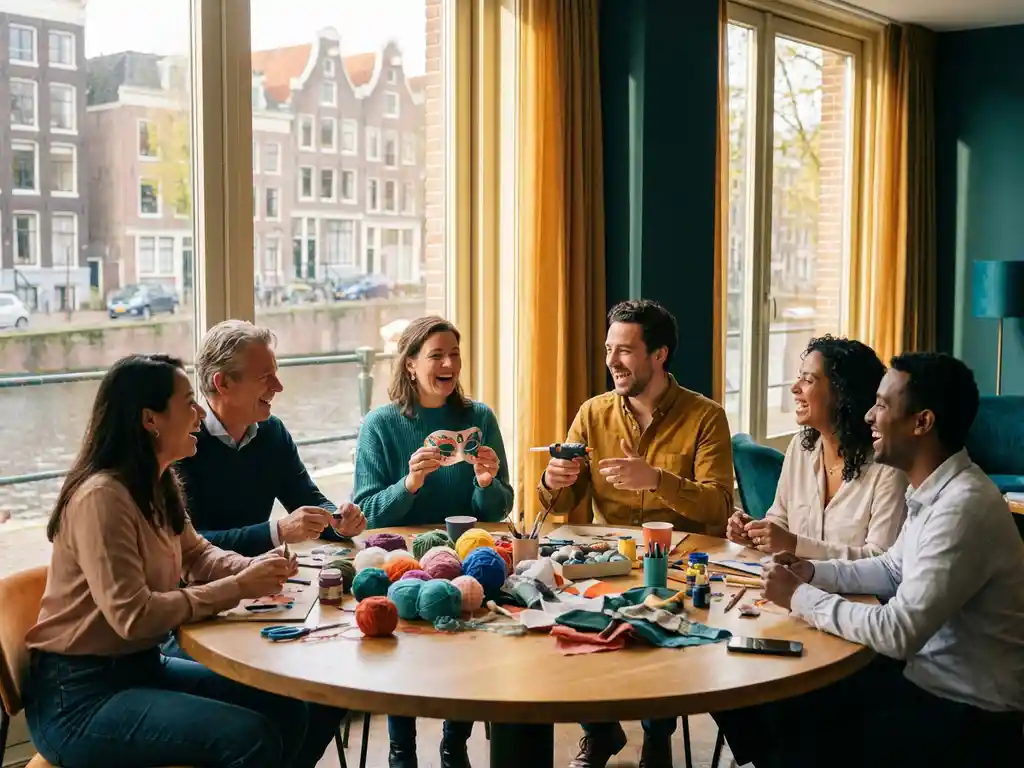
When teams only ever work with the same colleagues, organizations quietly develop blind spots. Silos form, communication breaks down, and collaboration becomes transactional rather than genuinely creative. Cross-departmental team building is one of the most effective ways to address this challenge, giving employees from different functions a shared experience that builds trust, improves communication, and reminds everyone that they are working toward the same goals.
The activities below are specifically designed for cross-functional team settings, where the mix of perspectives, roles, and working styles is the point. Whether you are organizing a company-wide event in Amsterdam or a smaller interdepartmental session, these eleven team-building activities offer something concrete, engaging, and genuinely useful for your teams.
Why cross-departmental team building matters
Interdepartmental collaboration does not happen automatically. Employees naturally gravitate toward familiar colleagues, and without deliberate effort, departments can operate as separate islands even within the same organization. This is a well-recognized challenge in larger companies, where teams are often so focused on their own projects and deliverables that they rarely interact with colleagues from other functions.
Cross-departmental team building creates structured opportunities for employees to connect outside their usual context. When people from finance, marketing, operations, and HR solve a problem together, they develop a richer understanding of each other’s roles, pressures, and strengths. That understanding pays dividends long after the activity is over, making future collaboration smoother and more effective. The activities below are chosen because they actively require mixed-team participation to work, making them ideal for breaking down departmental barriers.
1: Improv comedy workshops that break down barriers
Improv comedy workshops are one of the most effective cross-functional team activities available because they work regardless of job title, department, or seniority. The core principles of improvisation—listening actively, building on others’ ideas, and staying present in the moment—are skills that translate directly into better workplace communication and collaboration.
In a mixed-department setting, improv exercises level the playing field. A finance analyst and a creative director are equally capable of making each other laugh and equally vulnerable when stepping outside their comfort zones. That shared experience builds genuine connection quickly. Improv workshops also tend to surface communication habits and team dynamics in a low-stakes, playful environment, making them particularly valuable for teams that need to improve how they work together across functions.
2: Cross-team escape room challenges
Escape rooms are a well-established team-building exercise, but their real value for cross-departmental groups lies in the way they expose different problem-solving approaches. Engineers, marketers, and HR professionals all tend to approach puzzles differently, and an escape room forces those approaches into productive tension.
To maximize the cross-functional benefit, deliberately mix participants from different departments rather than letting colleagues self-select into teams. The challenge of coordinating with unfamiliar colleagues under time pressure mirrors real workplace dynamics, making the debrief conversation afterward particularly rich. Escape rooms work well for groups of any size when split into multiple mixed teams competing or collaborating simultaneously.
3: Collaborative storytelling and pitch sessions
Collaborative storytelling activities ask mixed teams to construct and present a narrative together, whether that is a fictional company pitch, a creative brief, or a story built one sentence at a time. These exercises develop communication skills while revealing how different departments frame problems and opportunities.
Pitch sessions are especially useful for cross-departmental employee engagement because they require participants to align on a shared message despite coming from different professional backgrounds. A sales professional and a product developer pitching the same idea together quickly discover how differently they naturally communicate, and that discovery is the learning. These sessions work well as standalone activities or as part of a longer workshop focused on organizational communication.
4: Interdepartmental trivia and quiz competitions
A well-designed trivia competition can be one of the simplest and most inclusive team-building activities for large, diverse groups. The key to cross-departmental impact is building question categories that draw on knowledge from across the organization, including company history, industry trends, and role-specific knowledge from different departments.
When trivia is structured so that each team genuinely benefits from having members with different professional backgrounds, it reinforces the value of diverse expertise in a lighthearted way. A customer service representative might know something an executive does not, and that moment of recognition matters. Trivia competitions are also easy to scale, making them a practical option for company-wide events with large numbers of participants.
5: Innovation hackathons with mixed-department teams
Hackathons have moved well beyond their origins in software development and are now a popular format for corporate team building across industries. The format asks mixed teams to develop and present a solution to a defined challenge within a set time frame, typically a few hours to a full day.
For cross-functional team activities, hackathons are particularly powerful because they require genuine collaboration across skill sets. A strong hackathon team needs creative thinkers, analytical minds, communicators, and practical implementers—roles that naturally map to different departments. The time constraint adds productive pressure, and the pitch at the end gives every team a moment of shared accomplishment. Choose a challenge that is relevant to the organization’s actual goals to maximize engagement and practical value.
6: Hosted panel discussions with employee spotlights
Panel discussions with employee spotlights are an underused format for cross-departmental connection. Rather than bringing in external speakers, these sessions place employees from different functions in conversation with each other, facilitated by a skilled host who draws out insights and keeps the energy high.
The format works because it humanizes colleagues across departments. When someone from logistics shares how their team navigated a major challenge, or a product manager explains their decision-making process, it builds empathy and understanding across the organization. A professional host is essential here—someone who can ask the right questions, manage the room, and create a conversation that feels genuine rather than scripted. This format pairs well with larger company events where you want to combine information sharing with genuine connection.
7: Cooking or creative challenges in mixed groups
Cooking challenges and creative activities like painting or craft projects are effective team-building exercises because they shift participants entirely out of their professional identities. In the kitchen or at an art table, job titles become irrelevant, and people connect as people rather than as colleagues with specific roles.
For cross-departmental groups, this neutrality is valuable. Employees who might feel intimidated by a business-focused activity often thrive in a creative or culinary setting, and the mix of skills required means that no single professional background has an obvious advantage. These activities also tend to generate a lot of laughter and spontaneous conversation, which builds social bonds that carry over into the workplace.
8: Communication masterclasses across teams
Communication masterclasses designed for mixed-department groups address one of the most persistent challenges in large organizations: the gap between how messages are sent and how they are received. When employees from different functions learn communication skills together, they develop a shared vocabulary and a shared set of tools for working across departmental lines.
Effective masterclasses go beyond theory and use interactive exercises, including storytelling, active listening practice, and presentation coaching, to give participants skills they can apply immediately. Bringing together employees from different departments in this kind of structured learning environment also creates natural opportunities for cross-functional relationship building. The combination of practical skill development and genuine human connection makes communication masterclasses one of the highest-value team-building activities for organizations dealing with silos or internal communication challenges.
9: Volunteer and social impact days
Shared purpose is a powerful connector, and volunteer days give cross-departmental teams a reason to work together that goes beyond the organization’s own goals. Whether planting trees, supporting a local food bank, or renovating a community space, social impact activities create a context where professional hierarchies fade and human connection takes over.
For interdepartmental collaboration, volunteer days work best when teams are deliberately mixed and given tasks that require coordination and communication. The physical, hands-on nature of most volunteer activities also tends to bring out sides of colleagues that rarely appear in office settings, making these experiences particularly memorable. Organizations that align their volunteer activities with their broader values tend to see the strongest engagement from participants.
10: Scavenger hunts through the city or office
Scavenger hunts are one of the most flexible corporate team-building formats available, adaptable to almost any group size, location, or budget. For cross-departmental teams, a well-designed scavenger hunt creates a shared adventure that requires communication, creative thinking, and genuine teamwork to complete.
City-based scavenger hunts, particularly in a city like Amsterdam with its rich geography and culture, add an extra layer of engagement by combining team building with exploration. Mixed-department teams navigating challenges together in an unfamiliar context quickly develop the kind of informal rapport that is difficult to build in a meeting room. Office-based versions work well for remote or hybrid teams coming together for an in-person day, creating shared memories tied to a physical space.
11: Custom-made video or comedy productions
Custom video or comedy productions ask mixed teams to collaborate on creating something together, whether that is a short film, a comedy sketch, or a branded video for internal use. The production process requires a genuinely diverse set of skills, from writing and performing to directing and editing, which makes it an ideal format for cross-functional collaboration.
Beyond the creative challenge, these productions tend to generate content that lives on after the event, giving teams a lasting artifact of their collaboration. Comedy productions in particular create an environment where laughter is the goal, which breaks down professional reserve and encourages people to take creative risks together. The result is both a memorable team-building experience and, often, something the organization can actually use.
Choosing the right activity for your teams
The best cross-departmental team-building activity is the one that fits your group’s specific needs, size, and goals. A large company-wide event calls for different activities than a focused interdepartmental workshop for two teams learning to collaborate more effectively. Consider what outcome matters most—relationship building, skill development, communication improvement, or simply shared fun—and choose activities that genuinely serve that goal.
It also helps to think about the mix of participants. Some activities, like improv workshops or communication masterclasses, work best when participants are willing to engage actively. Others, like scavenger hunts or cooking challenges, tend to draw in more reserved participants because the format itself does the work. The most effective cross-functional team activities are those where the structure naturally requires collaboration rather than simply hoping it will happen.
How Boom For Business helps with cross-departmental team building
We have spent over 30 years helping organizations connect, communicate, and collaborate more effectively through the power of humor, improvisation, and expertly facilitated experiences. At Boom For Business, we specialize in exactly the kind of cross-departmental team building that moves the needle on real organizational challenges, not just one-off fun days that are forgotten by Monday morning.
Here is what we bring to your cross-functional team activities:
- Improv-based workshops that develop active listening, communication, and collaboration skills across departments in a genuinely engaging way
- Custom-made comedy and video productions that bring mixed teams together around a creative challenge with a lasting result
- Communication masterclasses that give employees from different functions a shared toolkit for working across organizational lines
- Professional hosting and facilitation for panel discussions, company events, and large-scale team-building sessions that need energy, structure, and expertise
- Fully customized programs designed around your organization’s specific goals, culture, and team dynamics
Whether you are bringing together two departments that struggle to communicate or designing a company-wide event for hundreds of employees, we create experiences that build genuine connection and deliver lasting impact. Explore our team-building programs, discover our masterclass workshops, or learn how we help organizations build a positive culture through humor and human connection. Ready to get started? Visit Boom For Business and let us help you design a cross-departmental experience your teams will actually remember.
Frequently Asked Questions
How do we get buy-in from employees who are skeptical about team-building activities?
The key is to lead with purpose rather than just fun. Communicate clearly how the activity connects to a real organizational challenge — like improving cross-departmental communication or reducing friction between teams — so employees understand there is a genuine reason behind it. Choosing activities that are inherently engaging and low-pressure, such as cooking challenges or scavenger hunts, also helps skeptical participants ease in without feeling forced to perform. When people experience the value firsthand, skepticism tends to dissolve quickly.
How often should organizations run cross-departmental team-building activities to see lasting results?
A single event can spark connection, but lasting change requires consistency. Most organizations see meaningful results when they integrate cross-departmental activities into a regular rhythm — at least two to four times per year — rather than treating them as one-off occasions. Pairing structured activities with ongoing cross-functional initiatives, such as interdepartmental project teams or shared learning sessions, reinforces the relationships built during team-building events and keeps collaboration habits active between sessions.
What is the ideal group size for cross-departmental team building, and how do we handle very large organizations?
Most cross-departmental activities work best in groups of 8 to 20 people per team, which allows for genuine interaction without anyone getting lost in the crowd. For large organizations with hundreds of employees, the solution is to run multiple simultaneous mixed teams — for example, several escape room groups or competing hackathon teams — all participating in the same event. Formats like trivia competitions and scavenger hunts are specifically designed to scale this way, making them practical options for company-wide events without sacrificing the quality of cross-functional interaction.
How do we ensure the benefits of a team-building activity carry over into everyday work?
The debrief is where the real learning is locked in. Building a structured reflection session into every activity — where teams discuss what they noticed about communication, collaboration, and problem-solving — helps participants consciously connect the experience to their daily work. Following up with small, practical commitments, such as scheduling a cross-departmental coffee chat or collaborating on a shared project, gives the energy from the event somewhere to go. Without intentional follow-through, even the best team-building experience risks fading within a few weeks.
What if some employees are introverted or uncomfortable with high-energy activities like improv?
Comfort levels vary enormously across any group, and the best cross-departmental programs account for this by offering a range of formats. Activities like collaborative storytelling, cooking challenges, or volunteer days create natural opportunities for quieter participants to contribute meaningfully without requiring them to be the center of attention. A skilled facilitator also makes a significant difference — experienced facilitators know how to create psychological safety, adjust the energy of a room, and ensure that introverted participants feel included rather than pressured.
Can cross-departmental team building be effective for remote or hybrid teams?
Yes, though it requires more intentional design than in-person formats. Virtual escape rooms, online trivia platforms, remote hackathons, and facilitated video-based workshops can all deliver genuine cross-functional connection when well-executed. The most effective remote team-building activities mirror the core principle of their in-person equivalents: they require real collaboration to succeed, not just passive participation. For hybrid teams, in-person gatherings — even occasional ones — tend to have an outsized impact, so prioritizing at least one annual in-person cross-departmental event is worthwhile wherever possible.
How do we choose between a skills-focused activity like a communication masterclass and a purely social one like a cooking challenge?
The decision comes down to your primary goal. If your teams have a specific, identifiable challenge — such as poor cross-departmental communication or misalignment on shared projects — a skills-focused activity like a communication masterclass or improv workshop delivers more targeted, transferable value. If the priority is simply to humanize colleagues across departments and build informal social bonds, a cooking challenge, scavenger hunt, or creative production is often more effective because the relaxed format encourages natural connection. Many organizations get the best results by combining both approaches: a skill-building session paired with a social activity in the same event.
Related Articles
- 7 ways event moderation improves how your company is perceived by attendees
- How does an event presenter prepare for a topic they are not an expert in?
- What does a professional event host do during conferences?
- What are team building activities for improving feedback culture?
- 9 elevator pitch structures that work for any B2B sales situation