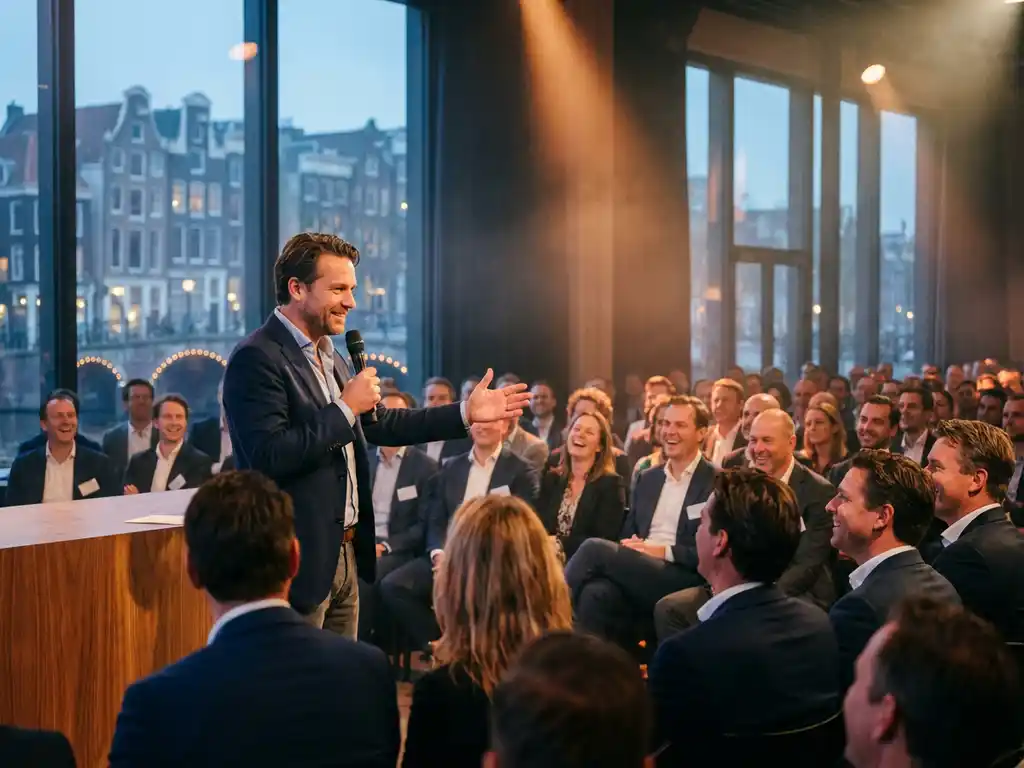
Hosting an internal corporate event is rarely as simple as it looks. Whether you’re running an all-hands meeting, a company milestone celebration, or a leadership offsite, the energy in the room depends heavily on the person at the front of it. A skilled corporate event host can transform a flat agenda into a genuinely memorable experience, while a poor one can leave even the best content falling flat.
If you’re weighing whether to bring in a professional host for your next internal event, this guide answers the questions that matter most—from what a host actually does to when it makes sense to hire one from outside your organization.
What does a corporate event host actually do?
A corporate event host manages the flow, energy, and atmosphere of an event from start to finish. They introduce speakers, guide transitions between segments, keep the audience engaged, handle unexpected moments with composure, and ensure the program stays on time without feeling rushed. Their role is equal parts logistics and performance.
Beyond the visible work of standing at a microphone, a professional host does significant preparation behind the scenes. They study the company’s culture, the event’s objectives, and the audience profile so that every comment, joke, or transition feels tailored rather than generic. They work closely with event organizers to understand what success looks like and then actively steer the event toward that outcome.
A great host also acts as a buffer. When a speaker runs long, a technical issue causes a delay, or the energy in the room dips, the host absorbs that friction and keeps the audience comfortable and attentive. That invisible problem-solving is often what separates a smooth event from a chaotic one.
Why does the host make or break an internal event?
The host sets the emotional tone of an internal event. Employees take their cues from whoever is at the front of the room. If the host is stiff, disengaged, or clearly reading from a script, the audience mirrors that energy. If the host is warm, sharp, and genuinely present, the room follows. No amount of polished slides can compensate for a host who fails to connect.
Internal events carry a unique challenge that external conferences do not. Employees often arrive skeptical, especially if they’ve sat through too many all-hands meetings that felt like a waste of time. A professional host understands this dynamic and works to earn trust quickly, using humor, directness, and genuine engagement rather than corporate formality.
There’s also the matter of credibility. When a company invests in a professional host, it signals to employees that the event matters. That perception shapes how seriously people engage with the content being delivered, whether that’s a strategy update, a culture initiative, or a team-building program.
What qualities should a corporate event host have?
The most effective corporate event hosts combine strong communication skills, quick thinking, genuine warmth, and an understanding of business environments. They can read a room, adapt on the fly, and hold attention without overshadowing the event’s core message. Experience in front of live audiences, ideally in professional or corporate settings, is essential.
Key qualities to look for
- Adaptability: The ability to adjust tone, pace, and content in real time based on audience response
- Business acumen: Understanding of corporate culture, organizational dynamics, and professional boundaries
- Humor and warmth: The capacity to be genuinely funny and human without being inappropriate or alienating
- Preparation discipline: A commitment to understanding the event’s goals and the company’s context before stepping on stage
- Composure under pressure: The ability to handle technical failures, timing issues, or difficult audience moments without losing control of the room
It’s worth noting that business-friendly humor is a distinct skill. A host who performs well in a comedy club may not automatically translate to a corporate boardroom. The best corporate event hosts understand where the line is and consistently work within it, making the audience feel energized rather than uncomfortable.
How does a professional host improve employee engagement?
A professional host improves employee engagement by creating an environment where people feel included, entertained, and respected. Rather than passive recipients of information, employees become active participants in the event experience. A skilled host uses interactive moments, well-timed humor, and direct acknowledgment of the audience to keep attention high throughout the program.
Engagement is not just about keeping people awake. It’s about ensuring that the messages delivered during an event actually land and are retained. When content is framed by a host who understands how to build energy and create emotional connection, employees are more likely to internalize what they hear and feel positively about the organization delivering it.
This matters particularly for change management and internal communication events, where leadership needs employees to not just hear a message but believe in it. A host who can acknowledge the human side of organizational change, with honesty and even a touch of humor, does far more to build trust than a formal presenter reading bullet points from a deck.
When should a company hire an external event host?
A company should hire an external event host when the event is high-stakes, when the internal team lacks hosting experience, or when fresh energy and credibility are needed. This includes company-wide meetings, leadership summits, culture or change initiatives, awards ceremonies, and team-building events where the audience needs to feel genuinely engaged rather than simply informed.
Internal hosts, such as a senior manager or HR leader, often struggle to fully play both roles simultaneously. When someone is responsible for the content of an event, they cannot also give their full attention to managing the room’s energy and flow. Splitting those responsibilities by bringing in a dedicated external host frees internal stakeholders to focus on their message.
External hosts also bring neutrality. They have no internal politics, no departmental allegiances, and no history with the audience that might color how they’re perceived. That independence gives them a unique ability to address sensitive topics or unite a diverse audience without the baggage that internal presenters sometimes carry.
What’s the difference between a host, an MC, and a facilitator?
A host manages the overall atmosphere and flow of an event, keeping the audience engaged and transitions smooth. An MC, or master of ceremonies, is a more formal role focused on introducing speakers and segments, typically at structured ceremonies or galas. A facilitator leads interactive sessions, workshops, or discussions, guiding group participation toward a specific outcome.
When each role applies
In practice, the lines between these roles often overlap, and many professionals can perform all three depending on the context. However, understanding the distinctions helps you hire the right person for your specific event format.
- Host: Best suited for full-day conferences, company meetings, and events where energy management across multiple segments is the priority
- MC: Ideal for award ceremonies, formal dinners, or structured programs where the role is primarily to introduce and hand off
- Facilitator: Essential for workshops, strategy sessions, and team-building activities where group participation and guided discussion are the core deliverable
For internal corporate events, you often need someone who can blend all three capabilities. A host who can also facilitate an interactive segment or guide a Q&A session with genuine skill is significantly more valuable than someone who can only perform one function.
How Boom For Business Elevates Your Internal Events
We bring together everything that makes a corporate event host truly worth the investment: professional hosting experience, business-friendly humor, and a deep understanding of how to engage real audiences in real organizational contexts. Built on more than 30 years of live performance expertise from Boom Chicago, our approach is designed specifically for companies that want their internal events to truly resonate.
Here’s what working with us looks like in practice:
- Experienced hosts who understand corporate culture and can adapt their style to your audience, whether that’s a 20-person leadership offsite or a 500-person all-hands meeting
- Custom-built programs that align with your event’s objectives, not a one-size-fits-all format
- Interactive elements and humor that break through communication fatigue and keep employees genuinely engaged
- Masterclass Workshops that combine professional development with the kind of energy and participation that makes learning stick
- Team-building experiences hosted by facilitators who know how to create connection without forcing it
- Support for positive culture initiatives that need more than a slide deck to resonate with employees
If you’re ready to stop settling for events that people forget by Monday morning, we’d love to show you what a professional host can do for your next internal event. Visit Boom For Business to explore our services and get in touch with our team.
Frequently Asked Questions
How far in advance should we book a professional corporate event host?
For most internal corporate events, booking 6–8 weeks in advance is a reasonable minimum, but high-stakes events like company-wide all-hands meetings or annual summits warrant booking 3–6 months ahead. This lead time allows the host to do meaningful preparation—learning your company culture, reviewing the agenda, and aligning with your event objectives—rather than arriving cold. Last-minute bookings are sometimes possible, but they limit the depth of customization that makes a professional host genuinely effective.
What information should we share with a professional host before the event?
At a minimum, share the event agenda, the audience profile (size, seniority mix, departments), the core objectives, and any sensitive topics or internal dynamics the host should be aware of. The more context a host has—including recent company news, cultural values, or inside references that resonate with employees—the more tailored and impactful their performance will be. Think of the briefing process as a collaboration, not just a handover of logistics.
What if our employees are resistant to or skeptical of 'corporate events'—will a professional host actually help?
A professional host is arguably most valuable precisely in this scenario. Experienced corporate hosts are trained to read skeptical audiences and disarm that resistance early through honesty, self-aware humor, and a tone that feels human rather than scripted. Rather than doubling down on corporate formality, a skilled host acknowledges the elephant in the room and uses that moment to build genuine rapport. Employees who came in rolling their eyes often leave having had a legitimately good time.
Can a professional host handle both large all-hands meetings and smaller leadership offsites, or do we need different people for each?
The best corporate event hosts are adaptable across formats and audience sizes, but it's worth asking any host you're considering about their specific experience with both. A 500-person all-hands meeting requires broad energy projection and tight pacing, while a 20-person leadership offsite calls for a more intimate, conversational style with room for nuance. Many experienced hosts can flex between both—just be explicit about the format during your briefing so they can calibrate their approach accordingly.
How do we measure whether a professional host actually improved our event?
The most practical measures are post-event employee surveys that ask specifically about engagement, energy, and whether the event felt worth their time—questions you can benchmark against previous events. You can also track more qualitative signals: Did people stay engaged throughout? Were transitions smooth? Did the event end on time? For events tied to specific goals like internal communication or culture initiatives, follow-up surveys two to four weeks later can reveal whether the messages actually landed and were retained.
What's a common mistake companies make when planning for a corporate event host?
One of the most frequent mistakes is treating the host as a last-minute logistics item rather than a strategic partner. Bringing a host in late, giving them a rigid script to read verbatim, or failing to brief them on the audience and objectives significantly limits what they can deliver. A professional host needs creative latitude and context to do their best work—the more you treat them as a collaborator from the planning stage, the better the outcome for everyone in the room.
Is business-friendly humor really necessary, or can we keep the event entirely professional and serious?
Humor isn't about entertainment for its own sake—it's one of the most effective tools for building trust, easing tension, and making content memorable. Research consistently shows that people retain information better when it's delivered in an engaging, emotionally resonant way, and well-placed humor is a key driver of that. That said, the right tone depends entirely on your audience and event context; a skilled host will calibrate accordingly, using warmth and levity where it serves the room without forcing it where it doesn't.