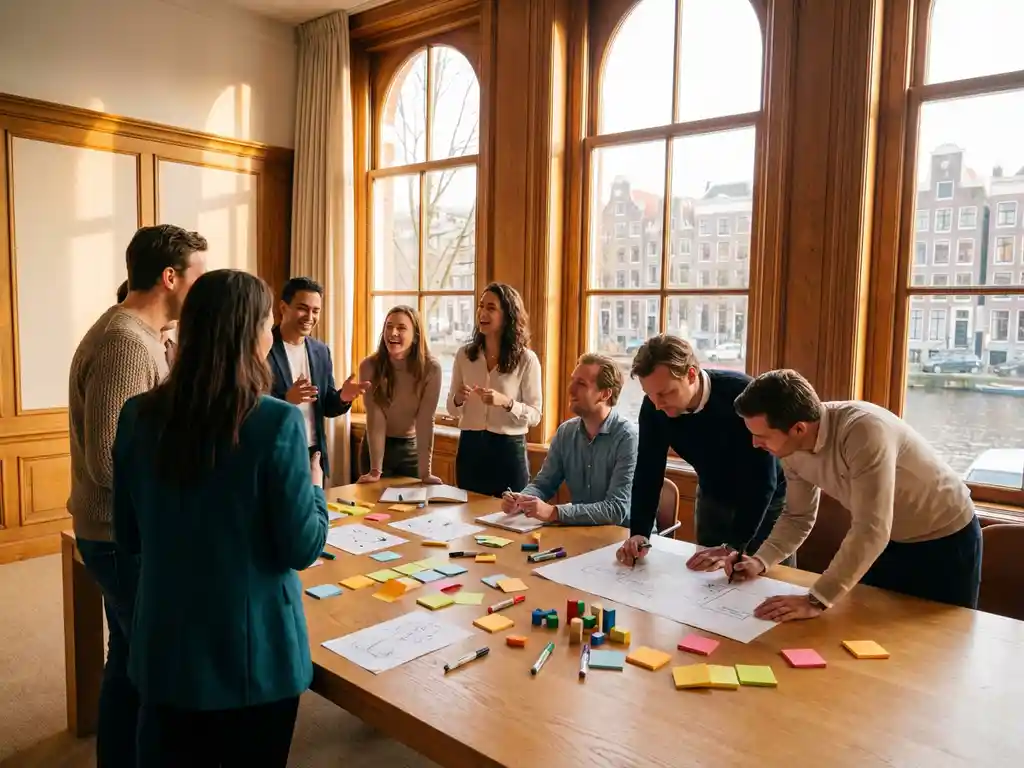
If you have ever tried to plan a professional development initiative for your team, you have probably encountered both terms: team communication training and team building. They sound related, and in many ways they are, but they serve different purposes and deliver different outcomes. Choosing the right one, or knowing when to combine them, can make the difference between a session that creates lasting change and one that people forget by Monday morning.
This article breaks down exactly what each approach involves, how they differ, and how to decide which one your team actually needs right now.
What is team communication training?
Team communication training is a structured learning program designed to develop specific communication skills in a workplace context. It focuses on how people exchange information, listen actively, give feedback, present ideas, and navigate difficult conversations, with the goal of making those interactions more effective and intentional.
Unlike general professional development, communication skills training is targeted. A program might focus on a specific challenge, such as cross-departmental clarity, leadership messaging, or presentation confidence. The learning is practical and skill-based, meaning participants leave with techniques they can apply immediately in their day-to-day work.
Good employee communication training typically covers areas like active listening, clear and concise messaging, nonverbal communication, feedback frameworks, and storytelling for business contexts. The emphasis is always on transferable skills rather than one-off activities.
What is team building, and what does it actually involve?
Team building is a broad category of activities and experiences designed to strengthen relationships, trust, and collaboration within a group. The primary goal is not skill development but connection—helping people understand each other better, break down social barriers, and work together more naturally.
Corporate team building can take many forms, from outdoor challenges and creative workshops to improv comedy sessions and shared experiences. What all effective team building activities have in common is that they create situations where people interact outside their usual work roles, which builds familiarity and psychological safety.
Team building works best when it is intentionally designed around the team’s actual dynamics. A newly formed team needs different experiences than a long-standing group dealing with tension or low morale. The best programs are tailored to the specific context rather than being generic fun days.
What’s the difference between team communication training and team building?
The core difference between team communication training and team building is their primary focus. Communication training develops individual and collective skills, while team building strengthens relationships and group cohesion. One is about capability; the other is about connection.
Here is how they compare across key dimensions:
- Goal: Communication training aims to improve how people exchange information. Team building aims to improve how people relate to one another.
- Output: Communication training produces transferable skills and behavior change. Team building produces stronger trust, morale, and team identity.
- Format: Communication training tends to be more structured and instructional. Team building tends to be more experiential and activity-based.
- Measurement: Communication training can be measured through observable behavior change. Team building is often measured through engagement scores and team sentiment.
- Duration of impact: Both require reinforcement, but communication skills need ongoing practice, while team-building benefits tend to be felt immediately and fade without follow-up.
It is also worth noting that the two are not mutually exclusive. Many of the best workplace communication programs blend both approaches, using relationship-building activities as the vehicle for practicing real communication skills.
When should a company choose communication training over team building?
Choose communication training when your team has a specific, identifiable skill gap that is affecting performance. If meetings are unproductive, presentations are unclear, feedback is avoided, or messages are consistently misunderstood, those are signals that skills need to be developed—not just that people need to spend more time together.
Communication training is also the right choice during periods of organizational change. When a company is going through restructuring, a merger, or a strategic shift, employees need practical tools to navigate uncertainty, communicate across new structures, and maintain clarity under pressure. A team day out will not solve that.
Other situations that call for dedicated communication skills training include:
- Onboarding new leaders who need to communicate with credibility and confidence
- Preparing teams for high-stakes presentations or stakeholder engagements
- Addressing persistent silos between departments
- Supporting managers who struggle to deliver clear, motivating messages
Team building, on the other hand, is more appropriate when the core issue is relational rather than skill-based. Low trust, poor morale, a newly formed group, or a team recovering from conflict are all situations where connection comes first.
Can team building and communication training be combined?
Yes, and in many cases, combining team building and communication training produces better results than either approach alone. When people feel comfortable with each other, they are more willing to practice new skills, take risks, and give honest feedback. That psychological safety is exactly what team building creates.
A combined program might use team-building activities as the warm-up and context, then layer in specific communication frameworks and techniques as the session progresses. Improv-based workshops are a strong example of this hybrid approach. Participants engage in exercises that are playful and social, while simultaneously practicing active listening, spontaneous storytelling, and clear expression under pressure.
The key to making a combined program work is intentional design. The activities need to be connected to the learning outcomes, not just entertaining. When fun and skill development are aligned, the experience becomes both memorable and genuinely useful.
How do you measure the impact of team communication training?
Measuring the impact of team communication training requires looking at both behavioral change and business outcomes. The most reliable indicators are observable shifts in how people communicate in real work situations, not just how they felt during the session.
Practical ways to measure effectiveness include:
- Pre- and post-assessments: Ask participants to self-rate specific communication skills before and after the program to identify perceived growth.
- Manager observation: Brief line managers before the training on which behaviors to look for, then check in after four to six weeks.
- Meeting quality feedback: Track whether meetings become shorter, more focused, or result in clearer action points over time.
- Employee engagement data: Communication training often has a positive effect on engagement scores, particularly around feeling heard and informed.
- 360-degree feedback: For leadership communication specifically, structured peer and direct-report feedback provides meaningful data.
The most important thing is to define success criteria before the training begins. Without a clear picture of what good looks like, it is difficult to know whether the program has moved the needle. Good facilitators will help you set those benchmarks as part of the design process.
How Boom For Business Helps with Team Communication Training and Team Building
We bring together the best of both worlds: structured communication skills development and high-energy team experiences that actually stick. Drawing on over 30 years of expertise from Boom Chicago, we design programs that are equal parts impactful and enjoyable, because we know that people learn best when they are engaged.
Here is what working with us looks like in practice:
- Masterclass Workshops focused on storytelling, presentation skills, and workplace communication, using improvisation techniques to make learning active and memorable
- Custom team-building programs designed around your team’s specific dynamics, goals, and challenges rather than off-the-shelf activities
- Facilitated experiences that blend humor, creativity, and professional development into a single cohesive session
- Programs tailored for international corporate environments, with experienced facilitators who understand the complexity of large organizations
Whether you need to sharpen your team’s communication skills, rebuild connection after a period of change, or create a memorable event that delivers real value, we have the expertise to make it happen. Explore our Masterclass Workshops, browse our team building programs, or discover how we help organizations build a positive culture through humor and human connection. Ready to get started? Visit Boom For Business and let us help you design an experience your team will actually talk about.
Frequently Asked Questions
How long should a team communication training program typically last to see real results?
There is no universal answer, but a single half-day or full-day session is rarely enough to produce lasting behavior change on its own. The most effective programs combine an intensive workshop with follow-up touchpoints, such as short reinforcement sessions, manager check-ins, or practice assignments over four to six weeks. Think of it less like a one-time event and more like a learning journey with a strong starting point.
What if our team is resistant to training or sees it as a tick-box exercise?
Resistance usually stems from past experiences with generic, poorly designed programs that felt like a waste of time. The best way to counter this is to be transparent about the specific problem the training is solving and involve the team in shaping the agenda. When people understand the 'why' and feel their input matters, buy-in increases significantly. Choosing a format that is engaging and activity-based, rather than lecture-heavy, also goes a long way toward shifting that skepticism.
How do we identify which specific communication skills our team actually needs to work on?
Start by looking at where communication is already breaking down in your day-to-day operations. Are meetings running over without clear outcomes? Is feedback rarely given or poorly received? Are cross-team projects plagued by misalignment? A short pre-training survey or a facilitated needs assessment with key stakeholders can quickly surface the most pressing gaps. A good training provider will help you run this diagnostic as part of the program design process rather than jumping straight to a solution.
Can communication training help with remote or hybrid teams, or is it mainly designed for in-person groups?
Communication training is arguably even more valuable for remote and hybrid teams, where the absence of in-person cues makes clarity, active listening, and intentional messaging more critical than ever. Many programs can be adapted for virtual delivery using breakout rooms, digital collaboration tools, and video-based exercises. The key is ensuring the format is interactive rather than passive, since engagement drops quickly in a virtual setting if participants are just watching a presentation.
How soon after a team conflict or period of tension should we run a communication training or team-building program?
Timing matters enormously here. If tensions are still raw, jumping straight into a high-energy team-building day can feel tone-deaf and may even deepen resentment. In most cases, it is worth addressing the underlying issues first, whether through facilitated conversations, leadership coaching, or mediation, before investing in a group program. Once there is enough psychological safety in the room, a well-designed combined program can be a powerful way to rebuild trust and establish healthier communication norms going forward.
What is the difference between hiring a communication trainer and using an internal HR-led program?
Internal HR-led programs have the advantage of existing organizational context and lower cost, but they can sometimes lack the credibility, neutrality, or specialist expertise that an external facilitator brings. An external trainer is often better positioned to challenge ingrained habits, introduce fresh frameworks, and create a space where participants feel safe to be honest without fear of internal politics. The best approach depends on your team's needs, but for high-stakes programs or senior leadership groups, external expertise typically delivers stronger results.
How do we make sure the skills learned in training actually transfer back to the workplace?
Transfer is the biggest challenge in any training program, and it does not happen automatically. The most effective way to bridge the gap between the session and real-world application is to build in structured follow-up: assign specific practice tasks linked to real work scenarios, brief managers on how to reinforce the skills in day-to-day interactions, and schedule a short review session a few weeks after the program. Framing the training as the beginning of a new habit rather than a standalone event is the mindset shift that makes the biggest difference.
Related Articles
- 9 team building activities that work for both introverts and extroverts
- 7 reasons team communication breaks down and how workshops fix each one
- How do you integrate team building into change management strategies?
- What are the benefits of professional team building hosts?
- How do you create meaningful connections through team building?